The National Development and Reform Commission issued a notice on the "National Carbon Peak Pilot Construction Plan".
Development and Reform Commissions of all provinces, autonomous regions, municipalities directly under the Central Government, cities specifically designated in the state plan, and the Xinjiang Production and Construction Corps:
In order to implement the relevant deployment of the State Council's "Action Plan for Carbon Peaking Before 2030" (Guo Fa [2021] No. 23), select 100 typical representative cities and parks across the country to carry out pilot construction of carbon peaking, explore the carbon peak path of cities and parks with different resource endowments and development bases, and provide operable, replicable and generalizable experience and practices for the whole country.
National Development and Reform Commission
October 20, 2023
National carbon peak pilot construction plan
In order to fully implement the spirit of the 20th National Congress of the Communist Party of China, conscientiously implement the decisions and arrangements of the Party Central Committee and the State Council, and in accordance with the "Opinions of the Central Committee of the Communist Party of China and the State Council on Completely, Accurately and Comprehensively Implementing the New Development Concept and Doing a Good Job in Carbon Peak and Carbon Neutrality" and the relevant deployment requirements of the State Council's "Action Plan for Carbon Peaking Before 2030", this plan is formulated.
1. General requirements
(1) Guiding ideology. Guided by Xi Jinping Thought on Socialism with Chinese Characteristics for a New Era, fully implement the spirit of the 20th National Congress of the Communist Party of China, and thoroughly implement Xi Jinping Thought on Economy and Ecological Civilization. Fully implement the new development concept, accelerate the construction of a new development pattern, focus on promoting high-quality development, and select 100 typical representative cities and parks across the country to carry out pilot construction of carbon peaking in accordance with the overall deployment of the national carbon peak and carbon neutrality work, focus on breaking the bottlenecks and constraints faced by green and low-carbon development, stimulate local initiative and creativity, and promote pilot tasks, implement key projects, Innovate policies and mechanisms, accelerate the green transformation of development modes, explore carbon peak paths for cities and parks with different resource endowments and development bases, and provide operable, replicable and scalable experience and practices for the whole country, so as to help achieve the goal of carbon peak and carbon neutrality.
(2) Working principles
-- Insist on being active and prudent. Focus on the key areas and key links of carbon peak and carbon neutrality, focus on exploring effective practices, typical experiences, policy mechanisms and carbon peak paths in different regions, respect objective laws, scientifically grasp the rhythm, and do not simply measure the effectiveness of work by the time of peak peak or the level of peak.
-- Persist in adapting measures to local conditions. Fully consider the location characteristics, functional positioning, resource endowment and development foundation of different pilots, determine the goals and tasks of pilot construction according to local conditions, and explore diversified green and low-carbon transformation paths.
-- Persist in reform and innovation. Firmly establish the concept that lucid waters and lush mountains are invaluable assets, continue to deepen reforms, carry out institutional innovation, strengthen policy supply, and continuously improve policy mechanisms conducive to green and low-carbon development.
– Adhere to safe carbon reduction. Coordinate development and security, adhere to the principle of establishing first and then breaking down, properly prevent and resolve risks and challenges that may arise in exploration, and effectively ensure national energy security, industrial and supply chain security, food security, and the normal production and life of the people.
Second, the main objectives
By 2025, positive progress will be made in the carbon peak and carbon neutrality work of pilot cities and parks, the policy mechanism conducive to green and low-carbon development within the pilot scope will be basically constructed, a number of operable, replicable and promotable innovative measures and reform experience will be initially formed, the carbon peak path of cities and parks with different resource endowments, different development bases and different industrial structures will be basically clear, and the demonstration and leading role of the pilot in the national carbon peak and carbon neutrality work will gradually emerge.
By 2030, significant progress will be made in the comprehensive green transformation of the economic and social development of pilot cities and parks, key tasks, major projects and important reforms will be completed as scheduled, and policy mechanisms conducive to green and low-carbon development within the pilot area will be fully established.
Third, the construction content
(1) Determine the pilot tasks. Pilot cities and parks should systematically sort out the foundation and progress of their own carbon peak and carbon neutrality work in accordance with the overall deployment of the national carbon peak action and the work requirements of the region, deeply analyze the key constraints faced by the green and low-carbon transformation, and plan and deploy pilot construction tasks around the green and low-carbon transformation of energy, industrial optimization and upgrading, energy conservation, carbon reduction and efficiency improvement, and clean and low-carbon transformation in the fields of industry, construction, and transportation.
(2) Implement key projects. Pilot cities and parks should plan and implement a number of key projects in the fields of energy infrastructure, energy conservation and carbon reduction transformation, advanced technology demonstration, environmental infrastructure, resource recycling, ecological protection and restoration, etc., in combination with the pilot objectives, so as to form a strong support for the carbon peak and carbon neutrality work of the pilot cities and parks. It is necessary to strengthen the guarantee of various elements for the construction of supporting projects and promote the orderly implementation of key projects.
(3) Strengthen scientific and technological innovation. Pilot cities and parks should strengthen scientific and technological support and guidance, and support scientific research units, universities, and enterprises to carry out applied basic research and key technology research and development around green and low-carbon. It is necessary to innovate the mechanism for the promotion and application of green and low-carbon technologies, vigorously cultivate green and low-carbon industries, support and guide enterprises to actively apply advanced and applicable green and low-carbon technologies, and strive to form new industrial competitive advantages. It is necessary to strengthen the training, introduction and use of professional talents for carbon peak and carbon neutrality, and promote the improvement of the discipline system for carbon peak and carbon neutrality.
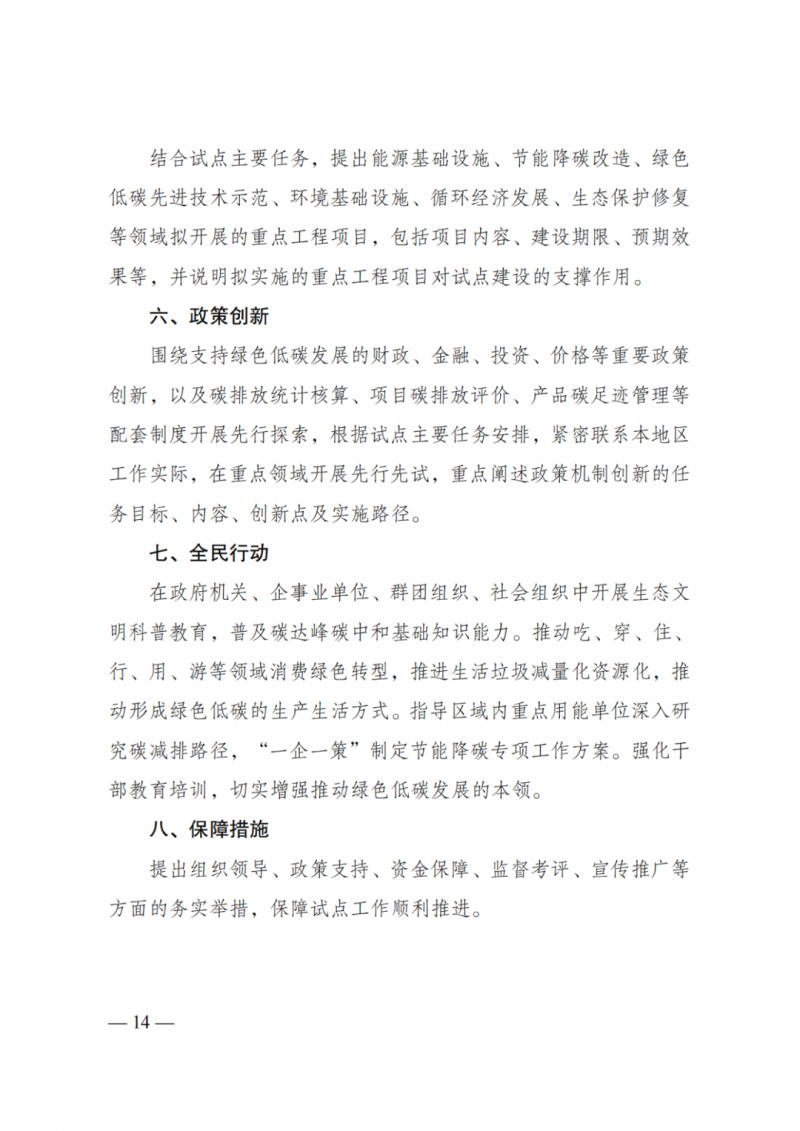
(4) Improve policy mechanisms. Pilot cities should deeply analyze the shortcomings of the current system and mechanism for green and low-carbon development, accelerate the establishment and improvement of fiscal, financial, investment, price policies and standard systems conducive to green development, innovate carbon emission accounting, evaluation and management mechanisms, and promote the overall improvement of urban energy efficiency and carbon efficiency. The pilot park should accelerate the establishment of a carbon emission control-oriented management mechanism, and strive to improve the level of green, low-carbon and circular development of the park.
(5) Carry out national actions. Pilot cities and parks should focus on strengthening popular science education on ecological civilization for the public and popularizing the basic knowledge of "double carbon". It is necessary to vigorously promote the concept of green and low-carbon life, promote green consumption, and innovate and explore institutional mechanisms such as green travel, stopping waste, and garbage classification. It is necessary to guide enterprises and institutions to strengthen energy and resource conservation, improve the level of green development, and effectively enhance the theoretical level and professional ability of cadres at all levels to promote green and low-carbon development.
Fourth, organization and implementation
(一)确定试点名单。统筹考虑各地区碳排放总量及增长趋势、经济社会发展情况等因素,首批在15个省区开展碳达峰试点建设(名额分配安排见附件1)。试点城市建设主体原则上为地级及以上城市,试点园区建设主体为省级及以上园区。有关省区发展改革委要根据碳达峰碳中和工作实际、本地区城市和园区绿色低碳发展水平等情况,按照分配名额提出碳达峰试点城市和园区建议名单,报本地区人民政府同意后,于2023年11月15日前报National Development and Reform Commission确认。National Development and Reform Commission将根据首批试点推进情况,组织开展后续试点建设。
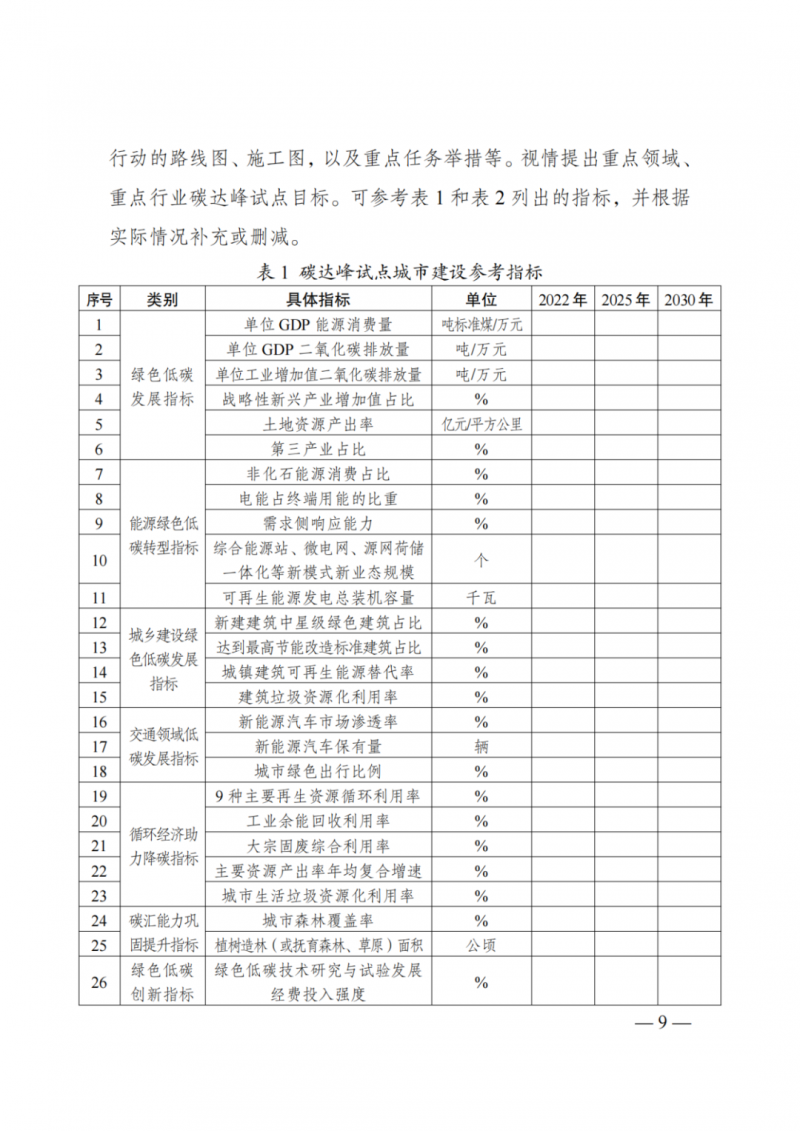
(二)编制实施方案。有关省区发展改革委要指导试点城市和园区按照《碳达峰试点实施方案编制指南》(附件2)要求,结合自身实际科学编制试点实施方案,明确重点任务、改革举措、重大项目和工作进度安排,报National Development and Reform Commission审核并按照审核意见进行修改完善,经本地区人民政府同意后,以试点所在省区省级发展改革委或所在城市人民政府名义印发,并抄报National Development and Reform Commission。
(三)开展试点建设。各试点城市人民政府和试点园区管理机构要切实担负起主体责任,完善工作机制,明确各方职责,按照实施方案扎实开展建设。有关省区发展改革委要认真履行指导责任,督促试点城市和园区推进各项重点工作,及时协调解决试点建设中遇到的困难和问题,加大政策和资金支持力度,确保工作取得实效。National Development and Reform Commission将会同有关方面统筹现有资金渠道,对符合要求的试点建设项目予以支持。鼓励金融机构支持碳达峰试点城市和园区建设,综合运用绿色信贷、绿色债券、绿色基金等金融工具,按市场化方式加大对相关绿色低碳项目的支持力度。
(四)加强总结评估。有关省区发展改革委要组织试点城市和园区定期开展建设情况总结评估,系统梳理试点工作进展成效,深入分析试点建设中遇到的问题,及时将有关情况报送National Development and Reform Commission。National Development and Reform Commission将会同有关方面加强对试点工作指导和督促检查,组织行业专家和专业机构提供政策指导和技术帮扶,对试点成效突出的城市和园区予以通报表扬,对工作进度滞后、试点效果不彰的试点及所在地区进行督促并责令限期整改。
(五)做好经验推广。试点城市和园区要及时梳理总结有推广价值的经验模式、典型案例和成功做法,归纳后形成信息上报。有关省区发展改革委要将行之有效的经验做法在本地区率先推广,推动转化为地方法规、政策制度、标准规范等。National Development and Reform Commission将组织开展多种形式的试点经验交流活动,宣传推广绿色低碳发展创新模式和典型经验。
Annex:
1. Quota arrangements for the first batch of national carbon peak pilots
2. Guidelines for the preparation of the pilot implementation plan for carbon peaking