


How to control qi in the Beijing-Tianjin-Hebei region and surrounding areas, and the Fenwei Plain in autumn and winter?
With the release of the "Plan for Comprehensive Control of Air Pollution in the Autumn and Winter of 2023-2024 in the Beijing-Tianjin-Hebei Region and Surrounding Areas and the Fenwei Plain" (hereinafter referred to as the "Plan"), the key areas of air pollution prevention and control in China have a new round of "road map" for air pollution control in autumn and winter.
What are the key points worthy of attention in the "Plan"? The reporter contacted experts in the industry to interpret them.
The scope of implementation is in line with the Action Plan for Continuous Improvement of Air Quality, covering 51 cities
In the autumn and winter of 2017-2018, the Action Plan for Comprehensive Air Pollution Control in the Autumn and Winter of 2017-2018 in Beijing-Tianjin-Hebei and Surrounding Areas was issued, focusing on the "2+26" cities of the air pollution transmission channel in Beijing-Tianjin-Hebei and surrounding areas for the first time.
In the autumn and winter of 2020-2021, the action plan for tackling key problems in Beijing-Tianjin-Hebei and its surrounding areas and the Fenwei Plain was combined into one.
In the autumn and winter of 2021-2022, the relevant plan will increase the number of cities in northern Hebei, northern Shanxi, eastern and southern Shandong, and southern Henan, focusing on 59 cities, and other cities in the Yangtze River Delta region will no longer be included in the scope of tackling tough problems, except for 7 cities in northern Jiangsu and northern Anhui.
The reporter noted that the implementation scope of the "Plan" is consistent with the scope of the Beijing-Tianjin-Hebei and surrounding areas and the Fenwei Plain in the "Action Plan for Continuous Improvement of Air Quality", covering 51 cities in 7 provinces (cities) including Beijing, Tianjin, Hebei, Shanxi, Shandong, Henan and Shaanxi.
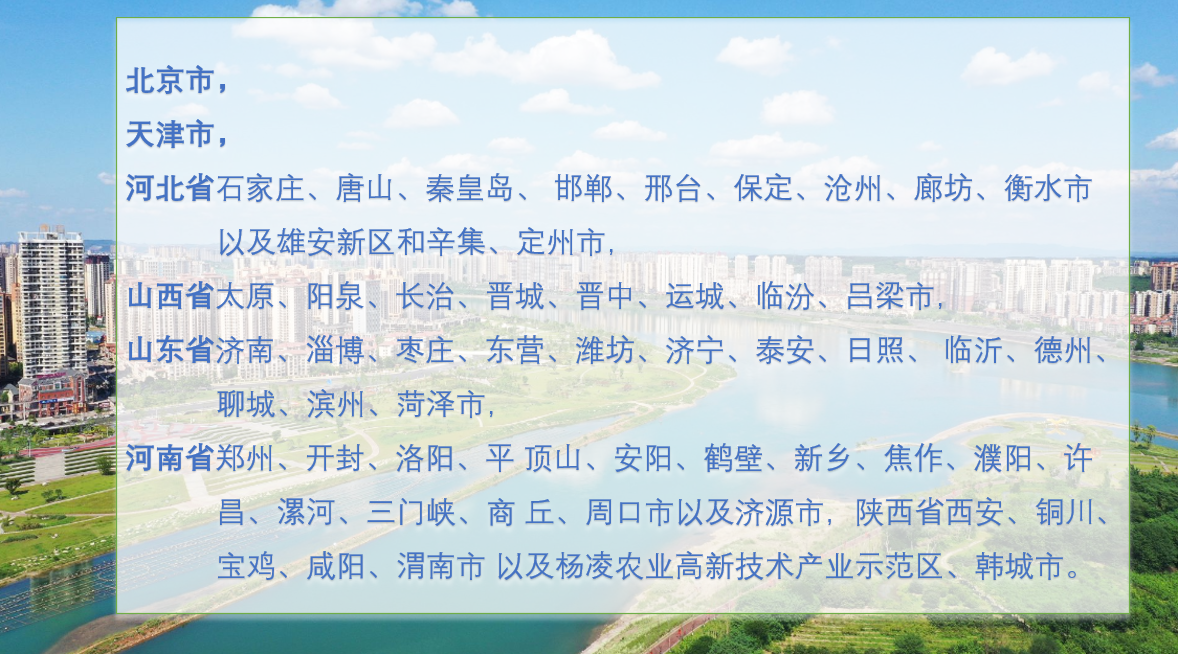
Although there have been obvious changes in the scope of implementation, it should be recognized that the Beijing-Tianjin-Hebei region and the surrounding areas, and the Fenwei Plain are still the top priorities in autumn and winter. Although positive results have been achieved in the autumn and winter in the past few years, the results of air quality improvement are not stable.
Beijing-Tianjin-Hebei and surrounding areas, Fenwei Plain PM2.5The average concentration significantly exceeds the national average, and the proportion of heavily polluted days in autumn and winter is very high, and most of the bottom 20 cities in the country's key cities are located in these two regions.
After combing, in the list of the bottom 20 cities in the air quality ranking of 168 key cities from January to November 2023 announced a few days ago, there are 18 cities in the scope of implementation this time.Although Mianyang and Changsha, which ranked 1st and 10th from the bottom, were not included in the scope of implementation, due to serious human interference, the maximum concentrations of 6 pollutants in their cities were replaced by the maximum values in that month.
"Plan" to reduce heavily polluted weather and reduce PM2.5concentration is the main goal, strengthen the coordinated control of multiple pollutants, and all cities in the implementation scope should be guided by the "Plan" to accurately and solidly promote various tasks and measures to effectively reduce air pollutant emissions.
The key tasks are "fine-tuned", and the ultra-low emission transformation of the steel, cement, and coking industries has been put to an important position
"In recent years, the top-level design of pollution control in key areas in China in autumn and winter, the policy context is basically the same, and the effective measures will be continued and implemented more refined. On this basis, the focus may be fine-tuned each year. Peng Yingdeng, a researcher at the National Urban Environmental Pollution Control Technology Research Center, said.
The Plan proposes six key tasks and measures, including orderly promotion of major projects in the 14th Five-Year Plan, in-depth promotion of comprehensive renovation of boilers and furnaces, continuous comprehensive treatment of mobile sources, efforts to improve the management level of atmospheric non-point sources, effective response to heavily polluted weather, and the creation of a number of benchmark enterprises for air treatment.
The first main task is clear, and high-quality ultra-low emission transformation projects in the steel, cement, and coking industries will be promoted. It is also proposed that by the end of December 2023, the ultra-low emission transformation of the whole process of the steel industry will be completed and the production capacity of the public will exceed 50 million tons.
This is tooFor the first time in the past, ultra-low emission retrofitting has been placed at such a high level。
Peng Yingdeng told reporters: "We have clearly seen that the steel, cement, coking industry in all pollution emission sources are the majority, and we have a clear source of carbon reduction as a new starting point for pollution reduction, the "plan" attaches importance to the ultra-low emission transformation of these three industries is a very good optimization, the purpose is to make precise efforts, guide the precise emission reduction of all places, improve the efficiency of pollution control. ”
"The National Development and Reform Commission, the Ministry of Ecology and Environment, the Ministry of Industry and Information Technology and other departments have issued a clear signal that the steel, cement, and coking industries should achieve carbon reduction and pollution reduction. It can also be seen from documents such as the Notice on Doing a Good Job in the Reporting and Verification of Greenhouse Gas Emissions of Enterprises in Some Key Industries from 2023 to 2025 that the cement, electrolytic aluminum and steel industries are expected to be included in the national unified carbon market. Peng Yingdeng said.
At the regular press conference of the Ministry of Ecology and Environment in March 2023, it was pointed out that due to the long steel (industry) chain, many pollution production links, and many unorganized emission links, the transformation of ultra-low steel emissions is an extremely difficult process.
At the same time, the meeting pointed out that despite the difficulties, with the active cooperation of iron and steel enterprises, the progress of ultra-low steel emissions is relatively good. According to the data, by the end of 2022, a total of 207 million tons of crude steel production capacity in the country has completed the whole process of ultra-low emission transformation and publicity, and 480 million tons of crude steel production capacity has completed the transformation of key projects such as sintering pellet desulfurization and denitrification, and material yard closure, accounting for two-thirds of the country's total production capacity. In the first three months of 2023, another 40 million tons of crude steel production capacity will complete the whole process of ultra-low emission transformation.
It is worth mentioning that the ultra-low emission of steel has cumulatively driven about 200 billion yuan of effective social investment, driving the rapid growth of environmental protection and related industries.
The "Plan" emphasizes the orderly promotion of major projects in the "14th Five-Year Plan" such as ultra-low emission transformation in steel and other industries, comprehensive treatment of VOCs, and scattered coal treatment.
"The comprehensive treatment of VOCs is a key point in the summer gas control, but it can be so valued and emphasized in the autumn and winter season, and it is also based on the current economic situation, hoping to stimulate social investment, expand domestic demand, and promote the development of green industries with governance. This is also the embodiment of the "Plan" to adhere to the general tone of seeking progress while maintaining stability, and strive to achieve a win-win situation of environmental, economic and social benefits. Peng Yingdeng said.
The control of heavy pollution days pays attention to methods and strategies, and clearly opposes "one size fits all"
The frequent and frequent occurrence of heavy pollution weather is one of the key problems to be overcome in autumn and winter.
In terms of air quality improvement targets, the Plan proposes that each city ensure that the 2023 air quality improvement targets issued by the higher-level people's governments are completed, and at the same time, the air quality improvement targets of each city are clarified in two stages: the fourth quarter of 2023 and the first quarter of 2024.
The reporter noted that from January to March 2024, some cities are under pressure. Among the air quality improvement targets of each city, the control targets for the number of days with severe pollution and above range from 1 to 12 days. Xianyang City has the most control days with 12 days, followed by Luohe City and Xi'an City with 11 days.
In the face of top-down rigid targets, Peng Yingdeng suggested that the reporting and evaluation of bottom-up urban compliance plans should be increased, so as to enhance the accessibility of the goals, and urge all localities to implement more precise policies, control pollution scientifically, and control pollution in accordance with the law, and face them in a more "rational" and "flexible" way.
"Heavy pollution weather is the most concerned by the people, but it is also closely related to meteorological conditions. In the case that the occurrence of heavily polluted days and meteorological conditions have not yet been completely decoupled, local governments should remain soberly aware. Peng Yingdeng said.
Peng Yingdeng told reporters: "It is relatively easy to turn a polluted day into a good day. However, if in the case of large-scale, regional, and extremely unfavorable meteorological conditions, and it is difficult for pollutants to diffuse, even if unconventional measures are taken to reduce emissions and drastically reduce pollutants, it is still difficult to avoid heavy pollution days. ”
Peng Yingdeng believes that there should be no overly and one-sided emphasis on improving air quality through unconventional means in extremely bad weather.It is possible to reduce the peak and speed of heavy pollution days, but it is necessary to maintain a clear understanding, in this case, it is more important to give priority to ensuring people's livelihood and giving priority to ensuring basic production and life. All localities should take a clear-cut stand against "one size fits all" and resolutely prevent perfunctory responses and temporary clearances in order to accomplish the task objectives.
"Efforts should be made in peacetime, and all localities should continuously optimize and improve gas control measures according to one city, one line, and one enterprise. Precise policies are implemented to reduce the interference to the normal production of enterprises, strengthen people's livelihood guarantees such as heating, and strive to achieve the goals of the Plan. He said.


