


Small bamboo makes a big industry
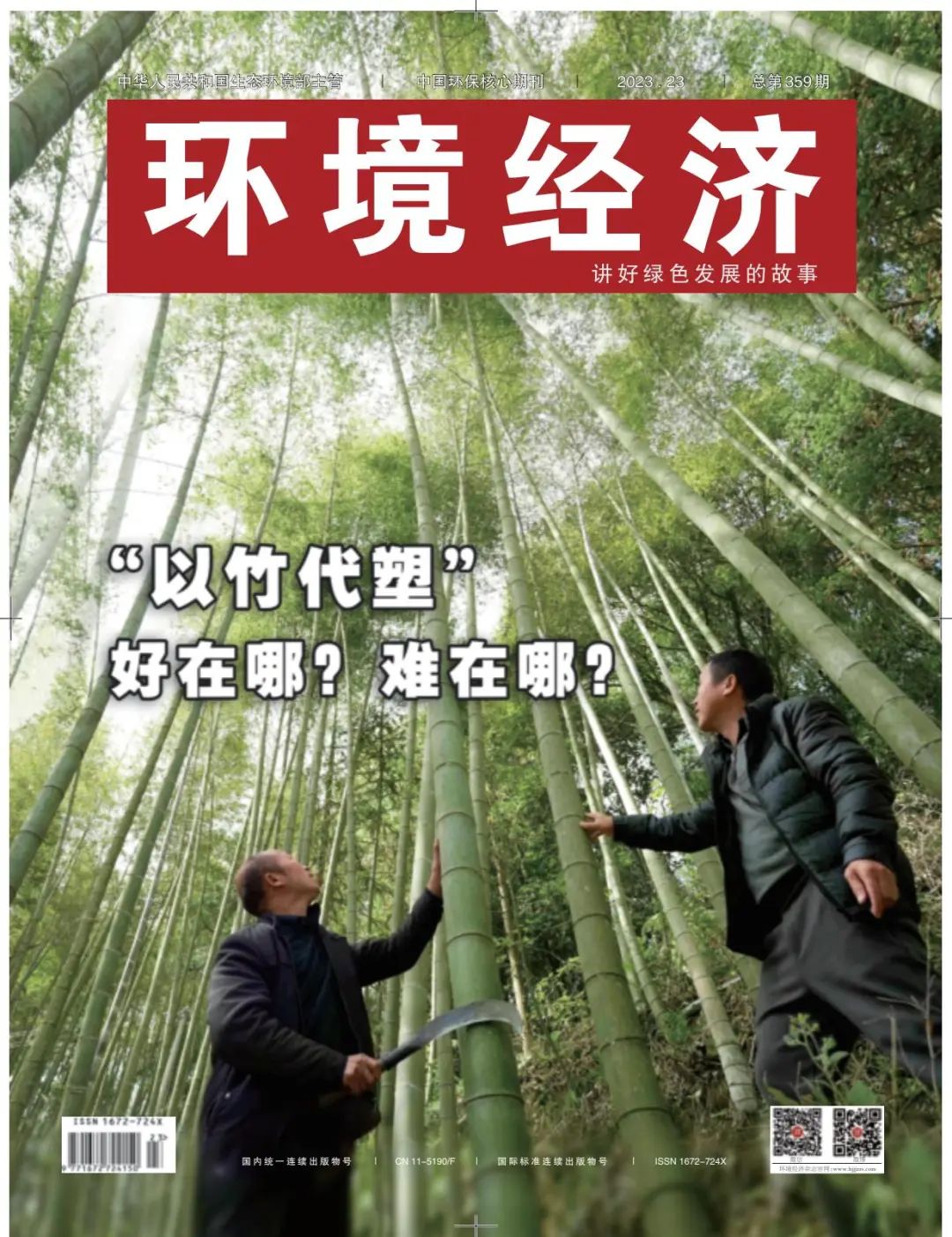
Bamboo, no plum blossoms are arrogant, no orchids are fragrant, no chrysanthemums are elegant, but they are called "four gentlemen". It is not only malleable, versatile, but also resolute, upright and knotty, integrating practical life and spiritual realm.
Su Dongpo, a writer in the Song Dynasty, once said: "The eater bamboo shoots, the shelterer bamboo tile, the bearer bamboo raft, the planer bamboo salary, the clothes bamboo skin, the calligrapher bamboo paper, the shoes of the shoe, it can really be said that one day can not be without this gentleman." He also said, "It is better to eat without meat than to live without bamboo." ”
It is reported that there are about 123 genera and 1642 species of bamboo subfamily plants in the world, and there are 837 species in 39 genera in China, accounting for 1/2 of the world, and it is the country with the most abundant bamboo resources and the longest history of bamboo cultivation and utilization in the world. China's bamboo industry spans primary, secondary and tertiary industries, with many categories. In 2021, the output value of the bamboo industry will be close to 381.8 billion yuan, and the total import and export trade of bamboo products will be 2.2 billion US dollars, accounting for more than 60% of the world's total bamboo product trade, and it is expected that by 2035, the total output value of China's bamboo industry will exceed 1 trillion yuan, accounting for about 10% of the forestry industry.
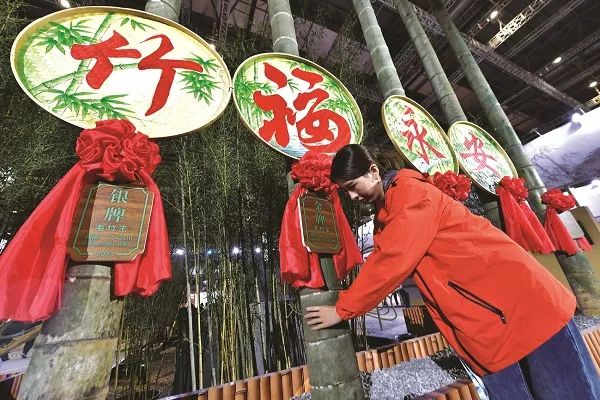
The development of the bamboo industry faces multiple challenges
Bamboo tableware, bamboo straws, bamboo carpets, bamboo paper bags, bamboo storage boxes...... At present, "replacing plastic with bamboo" and reducing plastic pollution is becoming a lifestyle fashion. As a green, low-carbon, and degradable biomass material, bamboo can replace plastic products in many fields and reduce pollution.
Gu Guangtong, director of the Institute of Ecological Civilization and the Institute of Ecological Economy of Zhejiang A&F University and the Institute of Carbon Neutrality, a new key professional think tank in Zhejiang Province, said in an interview with "Environmental Economy" that "bamboo instead of plastic" as a sustainable alternative has good ecological and environmental protection performance, which is reflected in five aspects. One is that bamboo is a fast-growing plant that can regrow in a short period of time. In contrast, plastics use finite resources such as petroleum and emit large amounts of carbon dioxide during production, while bamboo requires less energy and carbon emissions to produce and process. This helps to reduce greenhouse gas emissions and reduce the negative impact on climate change, and thirdly, bamboo is a natural organic material that can be naturally decomposed under the right environmental conditions. This means that products made from bamboo do not remain in the environment for a long time like plastic products, reducing pollution to soil and water bodies, fourth, bamboo growth requires less chemical fertilizers and pesticides, and less pollution to soil and water sources, and fifth, bamboo growth also helps to protect and restore ecosystems, promote soil conservation and water conservation. It can be seen that "replacing plastic with bamboo" can help reduce dependence on limited resources, reduce carbon emissions, reduce plastic pollution, and promote ecosystem protection.
China is an important advocate and practitioner of "replacing plastic with bamboo". In November 2022, China and INBAR jointly launched the "Bamboo instead of Plastic" initiative to deepen cooperation on "bamboo instead of plastic" around the world, increase the proportion of green bamboo products, and better leverage the outstanding advantages and role of bamboo in replacing plastic products, so as to further reduce the use of plastics and promote sustainable human development.
A few days ago, the National Development and Reform Commission and other departments issued the "Three-year Action Plan for Accelerating the Development of "Bamboo instead of Plastic", making it clear that by 2025, the "Bamboo instead of Plastic" industrial system will be initially established, and the product quality, product type, industrial scale and comprehensive benefits will be further improved, and the market share of key products will be significantly increased. Compared with 2022, the comprehensive added value of the main products of "bamboo instead of plastic" will increase by more than 20%, and the comprehensive utilization rate of bamboo will increase by 20 percentage points.
"With the support of policies and markets for environmentally friendly products, the application of 'bamboo instead of plastic' products in daily necessities, packaging materials, building materials and other fields will continue to expand. Gu Guangtong said that the industrialization development of "bamboo instead of plastic" has run out of "acceleration", which demonstrates China's determination to promote green development and will also bring new market opportunities. This will promote the development of the rural economy, promote green transformation, meet consumer demand for environmentally friendly products, and create more business opportunities and development space for enterprises.
Specifically, the development of "bamboo instead of plastic" as a sustainable alternative will not only help reduce the dependence on plastics, but also promote the development of bamboo planting and increase farmers' income; at the same time, bamboo can be used to make various products, such as paper, tableware, packaging materials, etc., the market demand for these products is increasing; in addition, the government's support and policy guidance for the "bamboo instead of plastic" industry is also an important factor to promote its development. The government can encourage enterprises to invest in and develop the "bamboo instead of plastic" industry through financial support and tax incentives, so as to further promote its industrialization process. In the future, the "bamboo instead of plastic" industry is expected to become one of the important industries to promote sustainable development, driven by the improvement of environmental awareness, policy support and technological progress.
Cheng Haitao, a researcher at the Institute of New Materials for Bamboo and Rattan Biomass at the International Center for Bamboo and Rattan at the National Forestry and Grassland Administration, told Environmental Economy that bamboo's fast growth, high yield and renewable advantages have made "bamboo instead of plastic" a high-profile emerging industry. Under the guidance of the policy, the "bamboo instead of plastic" industry is gradually rising and showing great potential.
In the interview, a number of experts said that although the development prospects of the "bamboo instead of plastic" industry are broad, it needs to be noted that there are still many shortcomings in the current development of "bamboo instead of plastic" in China, such as harvesting costs, technical equipment, market acceptance and other factors, and the accelerated development of the industry is still facing challenges.
- High harvesting costs. At present, most of the bamboo can only be harvested manually, trying to reduce labor consumption and expand profit margins, which will have a beneficial impact on the production enthusiasm of employees.
Wang Yixiang, director of the Institute of Ecological Civilization and the Institute of Low Carbon Development of the Institute of Carbon Neutrality of Zhejiang A&F University, a new key professional think tank in Zhejiang Province, told Environmental Economy that the cost of bamboo harvesting and transportation has been rising, the purchase price of bamboo has fallen year after year, the operating efficiency has decreased sharply, and the enthusiasm of bamboo farmers has been seriously frustrated.
Taking one ton of moso bamboo as an example, the labor cost of cutting, loading, and transportation is close to the average market price. The large-scale abandonment of moso bamboo forests has sounded the alarm for the development of the industry, and if no new development path is found, the abandoned area will continue to grow.
"Compared with traditional plastics, the cost of related bamboo products is higher, which will directly affect market competitiveness. Cheng Haitao told reporters that the key to solving this problem is to reduce production costs through technological innovation and scale effect.
-- The scale effect is poor. At present, the scale efficiency of the bamboo industry is poor, which is largely affected by the low level of automation of the processing of major bamboo products. Although China's bamboo resources are abundant, the bamboo industry has also developed rapidly in recent years, but many production workshops still need a lot of manual operation, the production line can not achieve automated assembly line production, it is expected that the upgrading of enterprise equipment will take a while.
"It's not a problem on the mountain, it's a problem down the mountain. Wang Yixiang analysis pointed out that at present, the bamboo industry is mostly small and medium-sized enterprises, and has not yet cultivated leading enterprises to drive the development of the industrial chain, failed to form an industrial agglomeration effect, and cannot compete with the leading enterprises of plastic products.
-- The level of technological maturity is not high. Cheng Haitao said that bamboo, as an alternative to plastic, needs to be further developed and researched to improve its plasticity, durability and processing performance to meet the needs of different fields.
- Low market acceptance. Compared with the higher-priced "bamboo instead of plastic" products, many consumers surveyed said that they still prefer to choose plastic products with lower prices. How to realize the transformation from "cheap, good to use" to "good to use and more environmentally friendly", and fully transform the concept of green environmental protection into practical actions, will also affect the in-depth development of the bamboo products consumer market.
"Today's consumers have no feelings for bamboo products and are not used to using bamboo products. Wang Yixiang told reporters that many young people are accustomed to using plastic bags, which are more convenient to use. At the same time, the price of bamboo products is relatively high compared to plastic products, which is difficult for most consumers to accept.
In Cheng Haitao's view, consumers have awareness and acceptance, and the promotion of "bamboo instead of plastic" products requires consumers' awareness and acceptance of environmental protection and green products. It is important to strengthen relevant publicity and publicity to improve consumers' awareness and acceptance of bamboo materials.
Solve the "stuck neck" puzzle
Verdant bamboo, one end is connected to green ecology, and the other end is connected to common prosperity. Breaking through the technical bottleneck of "stuck neck", how to make native bamboo become efficient recombinant wood? In this regard, in the interview, many experts expressed their opinions.
Many experts believe that in the initial stage of the development of the "bamboo instead of plastic" industry, the government needs to improve the capital subsidy system, focus on promoting the quality and efficiency of the bamboo forest base, and transform the low-yield and low-efficiency bamboo forest, so as to increase production capacity and reduce the cost of raw materials.
"To develop the industry, policy guidance is the 'weather vane'. Wang Yixiang told reporters that the government and relevant organizations need to strengthen the support and guidance of "bamboo instead of plastic", and introduce corresponding policy support and incentive measures, such as providing financial support, tax reductions or the development of environmental protection standards, etc., to scientifically guide the construction of industrial clusters, and to promote large-scale intensive production of industries with advantageous enterprises, and enhance the collaborative ability of the industrial chain.
At the same time, it is also necessary to strengthen the construction of the technical standard system of "bamboo instead of plastic" products, and speed up the formulation of bamboo structure design standards. Intensify the implementation of certification for green products such as bamboo building materials, bamboo furniture, and flooring, and encourage all parties to adopt and use the certification results; Encourage public institutions to actively purchase related "bamboo instead of plastic" products.
Gu Guangtong said that to solve this "stuck neck" problem, it is necessary to increase technological innovation in the field of "bamboo instead of plastic", improve the quality and performance of "bamboo instead of plastic" products, and improve the competitiveness of products; Technological innovation support, etc., to reduce the production cost and investment risk of enterprises, strengthen the formulation and implementation of environmental protection policies, encourage more enterprises to devote themselves to the environmental protection materials industry, increase marketing efforts, improve consumer awareness and acceptance of environmental protection products, strengthen the rational development and utilization of bamboo resources, and ensure the stability and sustainability of bamboo supply.
Cheng Haitao holds a similar view. He said that with technological innovation as the cornerstone, we will increase the research and development and innovation of bamboo instead of plastics, and improve the plasticity, durability, processing performance and functionality of bamboo materials. Through continuous improvement of technology, bamboo materials are more suitable for applications in different fields.
"The technical issues and the enterprises behind them are independent and controllable, and the intellectual property rights are under the rule of law. Chen Zhenliang, director of the Institute of Ecological Civilization and Carbon Neutrality of Zhejiang A&F University, told reporters that the development and research of bamboo products, production transformation, bamboo genome plan research and excellent bamboo seed screening, commodity trademark formulation and design of plastic products all involve the protection of intellectual property rights.
Chen Zhenliang said that strengthening the protection of intellectual property rights is the key to promoting innovation and technological progress and building a business environment based on the rule of law. Therefore, in the legislative, administrative, judicial and other links, we should continue to establish and improve the legal system for the protection of intellectual property rights, refine the supporting norms for scientific and technological promotion, tax incentives, ecological environment and other aspects that are more incentive-inducing, and protect the research and development results of enterprises "bamboo instead of plastic" and the legitimate rights and interests of the entire bamboo industry market entity in accordance with the law.
Specifically, it is necessary to strengthen the protection of patent rights, trademark rights and copyrights, so as to stimulate enterprises to invest more resources in innovation and technological iteration and upgrading, and enhance the competitiveness and sustainability of bamboo products in the alternative plastic market.
In addition, it is necessary to establish an effective market supervision system, strengthen the supervision and inspection of the quality and production process of bamboo products, and ensure that the products meet the standards; For enterprises that violate the rules, it is necessary to take swift and effective action to investigate and hold accountable according to law, so as to maintain the order of healthy competition in the entire market.
Chen Zhenliang told reporters that China's Global Action Plan (2023-2030) proposed by China is an important international practice for the construction of foreign-related rule of law. In the future, it is necessary to take the opportunity of "replacing plastic with bamboo" to encourage and support the modern bamboo industry to go international, actively participate in and even lead the formulation of international standards or rules related to "replacing plastic with bamboo", coordinate and promote the construction of domestic rule of law and foreign-related rule of law, and strengthen climate change, energy and environmental resources, food and health, agriculture and rural revitalization, investment protection, Internet and intellectual property rights, The construction of the rule of law in areas such as corporate compliance has created more favorable legal conditions and external environment for Chinese enterprises to go global and participate in international competition, and formed a joint rule of law force to protect and serve high-level opening up.
At the same time, Cheng Haitao said that consumers' awareness and acceptance of bamboo products also need to be improved. Although more and more people are beginning to pay attention to environmental protection and sustainability issues, many people do not know about bamboo products and are even skeptical of them. Therefore, it is necessary to increase consumer awareness and acceptance of bamboo products through publicity and education to promote the expansion of its market.
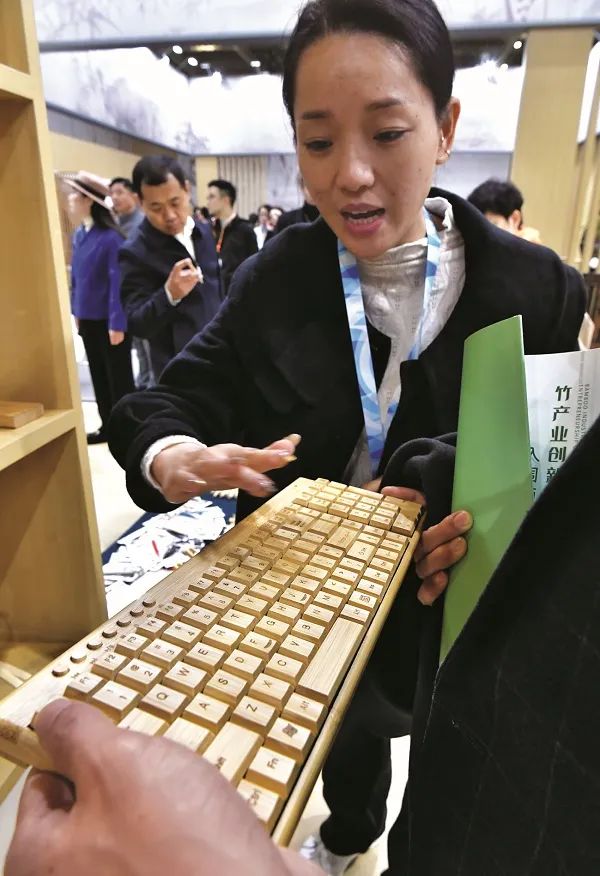
Bamboo computer keyboards are in the spotlight.
Enterprises rush to the beach
Bamboo is a common raw material and is often made into various utensils. We can find several things at home, such as bamboo chopsticks, bamboo mats, bamboo chairs, etc. However, what really makes bamboo shoulder the mission of replacing plastics is after Europe and the United States issued plastic restriction orders and China took the lead in proposing the "bamboo instead of plastic" initiative.
Some companies have already smelled the "business opportunity". Under the guidance of the "bamboo instead of plastic" initiative and a number of policies, a number of listed companies have actively developed bamboo products-related businesses, and some listed companies have continuously developed new products to promote the improvement of related production capacity.
Shuanggun Technology said on July 7, 2023 on the Shenzhen Stock Exchange that the company, as a leading enterprise in the bamboo products industry, has covered bamboo chopsticks, bamboo cutting boards, bamboo skewers and other products. As the company's second growth curve, the high-quality bamboo project mainly targets five categories: bamboo boards, bamboo chopsticks, bamboo sticks, bamboo charcoal and bamboo shoots. The company is actively expanding new products and production lines such as degradable tableware, bamboo barbecue sticks, barbecue charcoal, etc. In 2022, the company will successively invest in and build factories in bamboo resource gathering places such as Qingyuan in Zhejiang, Anji in Zhejiang, and Zixi in Jiangxi, giving full play to its advantages in production and manufacturing, and building a composite industrial chain of circular economy in the bamboo industry.
Shanying International announced in the 2023 semi-annual report that the Yibin Xiangtai Food Paper and Plastic Factory invested and built by the company in Xingwen County, Yibin City, took advantage of the local bamboo pulp and energy advantages, and built the company's first food paper and plastic production base in accordance with the strict requirements of the food packaging industry, with an existing annual production capacity of 20,000 tons.
Tsingshan Paper's 2023 semi-annual report disclosed that in 2023, on the basis of the successive completion and operation of the first project in the green circular economy industrial park, the company will actively plan to expand the area, continue to introduce high-related projects such as bamboo fiber post-processing and green packaging building materials, improve the front-end and back-end industrial support, and realize the sustainable development of leading drive, industrial agglomeration and clustering. Especially in terms of bamboo pulp products, the company has successfully developed and produced bamboo pulp products, and has become a domestic bamboo pulp production enterprise with a certain scale.
Cheng Haitao told reporters that the market behavior of enterprises rushing to lay out the beach, on the one hand, is to see the market potential and development opportunities, and on the other hand, it is also out of response to environmental awareness. Under the guidance of government policies, companies are actively exploring sustainable business opportunities, finding solutions to replace plastics, and launching more environmentally friendly products.
"From the perspective of the rule of law, the active participation of enterprises in the development of the 'bamboo instead of plastic' industry is an important embodiment of the positive response to national policies and laws and regulations, and reflects the full consideration of relevant factors such as the protection of the ecological environment, the fulfillment of social responsibilities and sustainable development. Chen Zhenliang said that this also reflects the self-regulation mechanism of the market, and reflects the legal consciousness and ecological consciousness of enterprises. The rule of law is not just a management tool unilaterally implemented by the government, but also an order formed through the joint efforts of market participants. Enterprises take the initiative to respond to the initiative of "replacing plastic with bamboo", which is not only due to the requirements of national policies and laws and regulations, but also out of the needs of market self-regulation. This kind of market behavior not only reflects the compliance of enterprises with the rule of law of the country, but also promotes the self-optimization and sustainable development of the market.
Chen Zhenliang told reporters that the company's active participation in the "bamboo instead of plastic" market will promote corporate compliance and promote the adjustment and upgrading of the industrial structure. This not only reflects the vitality of the market at the commercial level, but also promotes green, low-carbon and sustainable development within the framework of the rule of law. Due to the "plastic ban" and the "bamboo instead of plastic" initiative, companies have had to adjust their production and supply chains to adapt to new legal and regulatory requirements. This adjustment not only helps to reduce the adverse impact on the environment, but also helps to promote the greening and iterative upgrading of the entire industrial chain. From the perspective of the rule of law, the active adjustment and upgrading of enterprises in the market is conducive to building a healthier and more sustainable rule of law environment, and is an important embodiment of actively responding to the ESG (environmental, social, governance) standard system and rating services.
"At the same time, the participation of enterprises in the ranks of 'bamboo instead of plastic' will help cultivate and practice corporate social responsibility. Chen Zhenliang introduced that the construction of a rule of law and a beautiful China is not only the responsibility of the government, but also requires the active participation of enterprises. Through the "Bamboo instead of Plastic" initiative, companies are not only pursuing their own interests while complying with regulations, but also being socially and environmentally responsible. This sense of social responsibility not only helps companies transform ecological advantages into economic advantages and establish an image of sustainable business and "green enterprises", but also helps to build trust in society for the rule of law. Within the framework of the rule of law, corporate social responsibility behavior and eco-environment-oriented development (EOD) model are indispensable links in the construction of ecological civilization.
Chen Zhenliang told reporters that under the impetus of the national "plastic ban" policy and the "bamboo instead of plastic" initiative, enterprises are actively seizing the layout, which is a very positive market behavior. By complying with national policies and laws and regulations, actively promoting the upgrading of industrial structure, practicing social responsibility, and promoting market self-regulation, these market behaviors are not only a good performance of the business environment based on the rule of law, but also an effort to promote the development of society in a healthier, greener and more sustainable direction.
"This will also help guide consumers to purchase more environmentally friendly products and enhance social awareness of environmental protection. However, there may also be commercial interest-driven factors in the company's beach-rushing layout, Cheng said, and some of them may use it as a marketing tool to cater to consumer demand for environmentally friendly products.
Cheng Haitao said: "Enterprises need to be competitive and sustainable in the market, and we also need to carefully analyze market behavior and ensure that the quality and environmental performance of alternative products can meet the relevant standards." ”


