


International Energy Agency: Global nuclear power generation will reach a record high in 2025
According to the latest report released by the International Energy Agency, Electricity 2024, global electricity demand is expected to grow at an average annual rate of 3.4% between 2024 and 2026. The accelerated transition to clean energy will meet all of the world's new electricity demand over the next three years, with global nuclear power generation set to reach an all-time high by 2025.
Global nuclear power generation will be:2025The year reached an all-time high
The annual analysis of global electricity market developments and policies says electricity demand will grow, driven by booming emerging economies, artificial intelligence and data centers, with about 85% of the demand growth coming from China, India and Southeast Asia, while electricity consumption in advanced economies will decline. By 2025, the report predicts that global nuclear power generation is expected to reach an all-time high, as nuclear power generation climbs in France, several nuclear power plants in Japan resume operations, and new reactors in markets such as India, South Korea and Europe come into commercial operation.
According to the International Energy Agency, global nuclear power production is expected to grow by an average of about 3% between 2024 and 2026. In 2026, global nuclear power generation will increase by almost 10% compared to 2023. Plans for nuclear power plants under construction and new nuclear power plants show that the growth in nuclear power is coming from the Asian region.
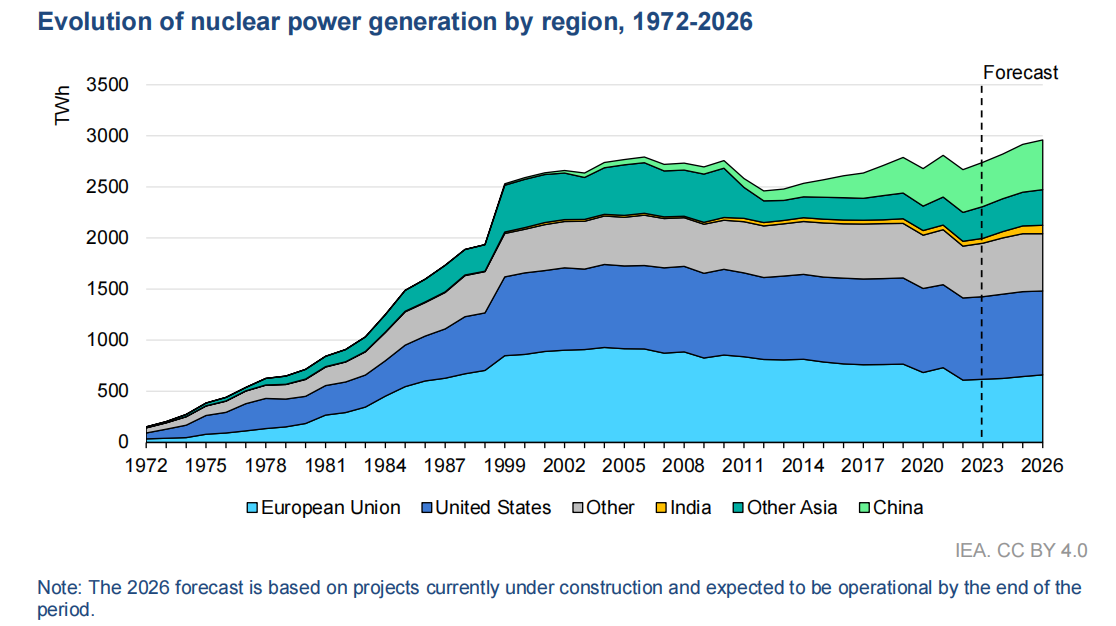
Image source: Report "Electricity 2024"
According to the reporter's understanding, the previous forecast data of a number of important international organizations and institutions have shown that the scale of global nuclear power will continue to grow. The World Nuclear Energy Association predicts that the global installed nuclear power capacity will reach 1 billion kilowatts by 2050. The International Atomic Energy Agency (IAEA) raised its forecast for global nuclear power growth for the third consecutive year in 2023. By 2050, there will be a quarter more nuclear capacity than in 2020, according to the International Atomic Energy Agency (IAEA), and the significant increase in installed capacity projections underscores that more and more countries are seeking clean and reliable nuclear energy to meet the challenges of energy security, climate change and economic development.
Low-emission energy will be2026It accounts for nearly the world's electricity generation every year50%
Electricity 2024 reports that low-emission energy sources, including renewables such as solar, wind and hydro, as well as nuclear power, will generate a record amount of electricity, reducing the share of fossil fuel power generation. By early 2025, renewables will overtake coal and account for more than one-third of the world's total electricity generation. By 2026, low-emission energy sources are expected to account for nearly 50% of global electricity generation.
Global electricity demand growth slowed slightly to 2.2% in 2023 due to lower electricity consumption in advanced economies, but is expected to grow at an average annual rate of 3.4% from 2024 to 2026, the report said. By 2026, about 85% of global electricity demand growth is expected to come from outside advanced economies.
IEA Governor Birol said that the power sector is currently producing more carbon dioxide emissions than any other sector, but it is encouraging that the rapid growth of renewables and the steady expansion of nuclear power are expected to combine to meet the growth in global electricity demand over the next three years. "This is largely due to the tremendous momentum of renewables, led by increasingly affordable solar, but also thanks to the significant return of nuclear power. ”
As a low-carbon emission energy source, nuclear energy has the advantages of high energy density, stable baseload power, and can effectively improve the energy self-sufficiency rate of load centers, and is gradually becoming a key force to accelerate the green transformation of development mode and actively and steadily promote carbon peak and carbon neutrality.
According to the 2023 national power industry statistics released by the National Energy Administration, as of the end of December 2023, the country's cumulative installed power generation capacity was about 2.92 billion kilowatts, a year-on-year increase of 13.9%. Among them, the installed capacity of solar power generation was about 610 million kilowatts, a year-on-year increase of 55.2%, the installed capacity of wind power was about 440 million kilowatts, a year-on-year increase of 20.7%, and the installed capacity of nuclear power was about 56.91 million kilowatts, a year-on-year increase of 2.4%.


