


The National Energy Administration released a list of 23 typical cases of green and low-carbon energy transformation
The reporter learned from the National Energy Administration on February 29 that the Comprehensive Department of the National Energy Administration recently announced the list of 23 typical cases of green and low-carbon energy transformation such as the "Nuclear Energy Heating Project of Shandong Haiyang Nuclear Power Plant".
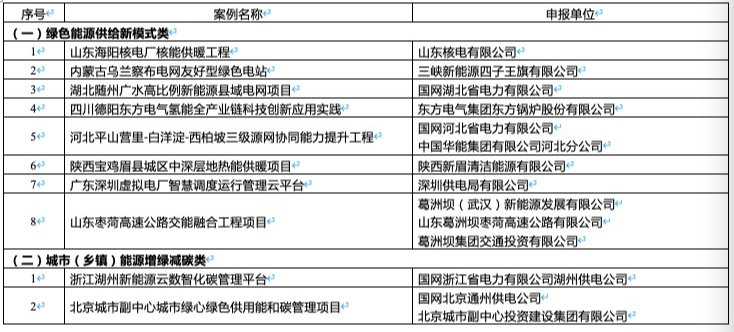
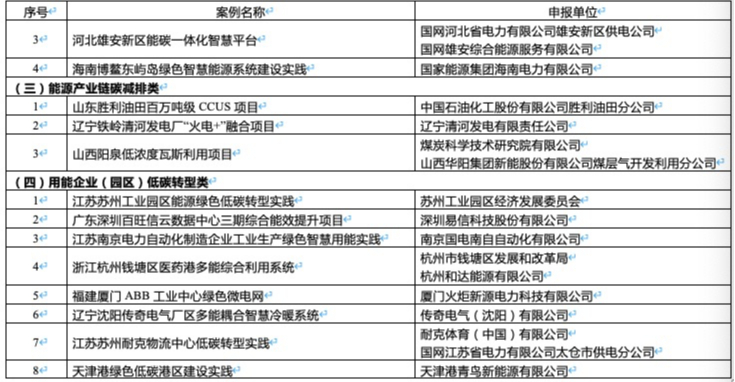
List of typical cases of green and low-carbon energy transformation Screenshot from the website of the National Energy Administration
How did typical cases come about?
The person in charge of the relevant department of the National Energy Administration said in response to a reporter's question,In recent years, energy development has deeply practiced the new energy security strategy of "four revolutions and one cooperation", accelerated the transformation of energy production and consumption patterns, developed clean energy rapidly, continuously optimized the energy structure, continuously innovated energy technology and development models, and emerged a number of excellent cases of green and low-carbon transformation and development. Typical guidance is an important practical method for energy work. The purpose of this collection of typical cases is to excavate, summarize, exchange and promote the successful experience and beneficial practices of energy transformation in various places, play a demonstration and leading role, provide practical support for accelerating the construction of a new energy system, and promote the high-quality development of national energy from point to point.
It is understood that the case collection has gone through the links of organization declaration, preliminary review recommendation, expert selection, case verification, and list publicity. In the process of case collection, all kinds of entities actively declared, and the provincial energy authorities recommended more than 150 cases after preliminary review, including county and district government departments, state-owned enterprises, private enterprises, foreign-funded enterprises, etc. In order to carry out the case selection work in a fair, just, scientific and standardized manner, the National Energy Administration has formulated the selection method and set up an expert group, with a total of 30 members from the fields of comprehensive energy planning, power system, new energy power generation, coal development and utilization, oil and gas development and utilization, nuclear energy, energy and chemical industry, energy market and policy research, carbon accounting and carbon market. Entrust the Electric Power Planning and Design Institute as an independent third party to organize an expert group to conduct case defense selection. Organize relevant provincial-level energy authorities, dispatched agencies of the National Energy Administration and selection expert groups to further carry out case verification. After selection and verification, the cases to be recommended were publicized to the whole society and accepted the supervision of all sectors of society. In the end, 23 cases were included as typical cases of green and low-carbon energy transformation.
How do the 23 typical cases reflect representativeness and what are the main characteristics?
According to the person in charge of the relevant department of the National Energy Administration, in order to highlight the representativeness of typical cases, on the whole, typical cases reflect the three characteristics of effectiveness, innovation and generalizability, that is, good practical results have been achieved, and they have strong innovation in terms of theoretical methods, technical equipment, operation modes, etc., and can play a role in promoting the development of the industry from point to area. The 23 typical cases cover all aspects of energy production and supply, processing and transformation, and terminal consumption, mainly including four categories: new models of green energy supply, urban (township) energy greening and carbon reduction, carbon emission reduction of energy industry chain, and low-carbon transformation of energy-using enterprises (parks), which are also highly representative in various fields.
Among them, the new model of green energy supply is mainly oriented to the production and supply of clean energy, and a total of 8 cases have been selected, showing the characteristics of diversified energy varieties and diverse energy supply methods, from different perspectives such as nuclear energy heating, wind-solar and storage integrated power stations, high proportion of new energy power grids, hydrogen energy production, storage and addition technology, smart distribution grids, geothermal energy heating, virtual power plants, and energy integration, etc., to explore innovative models of clean energy development and utilization in different fields, and strive to promote the safe and reliable replacement of traditional energy by new energy.
The urban (township) energy greening and carbon reduction category is mainly aimed at cities or towns that accelerate energy conservation and carbon reduction, and a total of 4 cases were selected, focusing on the overall synergy of green transformation on the energy supply side and energy conservation and carbon reduction on the energy consumption side. Taking the "Beijing Sub-central City Green Heart Green Energy Supply and Carbon Management Project" as an example, the case study realizes regional "greening" through the construction of ground source heat pump energy stations, distributed photovoltaics, water storage, etc., and promotes regional "carbon reduction" through green buildings, transportation electrification, smart energy management, carbon asset management, etc., and explores an effective path for the green and low-carbon transformation of urban (township) energy systems.
The carbon emission reduction category of the energy industry chain is mainly oriented to the production and processing of fossil energy, and a total of 3 cases were selected, starting from different fields such as oil exploitation, coal-fired power generation, and coalbed methane development, through the development of circular economy, the resource utilization of greenhouse gases such as carbon dioxide and methane, and the integrated development of traditional energy and new energy, so as to innovate the development model and explore a new path for the low-carbon transformation of the fossil energy industry.
The low-carbon transformation category of energy-using enterprises (parks) is mainly oriented to key energy-using fields, and a total of 8 cases have been selected, covering multiple energy-using scenarios such as industrial parks, data centers, logistics centers, production plants, and ports. The cases focus on the synergistic interaction between supply and demand, increase the supply of local renewable energy on the supply side, promote energy-saving transformation and improve the level of electrification on the energy consumption side, and carry out comprehensive intelligent scheduling to improve the overall efficiency of the system. The case provides a useful reference for enterprises of different sizes and different energy consumption characteristics for green and low-carbon transformation.
In the next step, how to give full play to the exemplary and leading role of good cases?
According to reports, in order to better play the demonstration and leading role of typical cases, the National Energy Administration will carry out several aspects of work in the next step. The first is to organize exchanges and seminars. Organize the compilation of the "Collection of Typical Cases of Green and Low-Carbon Energy Transformation", organize exchange and promotion meetings and seminars, invite relevant enterprises, research institutions, experts and scholars to participate, share the beneficial practices and successful experiences of typical cases, discuss the problems and solutions faced in the transformation, and discuss new models and paths for promoting energy transition and high-quality development. The second is to establish a tracking and evaluation mechanism. For the typical cases that have been announced, it is necessary to track the actual operation for a long time, continue to summarize practical experience, discover the problems encountered in the operation of the project in a timely manner, urge the project unit to manage the "business card project", and conduct post-evaluation of some projects if necessary. The third is to do a good job in publicity and promotion. Through media reports, online platforms, industry conferences and other channels, publicize and promote typical cases, convey successful experiences and good practices, fully mobilize the enthusiasm of all parties to promote energy transition, and promote the formation of green and low-carbon production methods and lifestyles.


