


Academician Liu Wenqing: In the next 10 years, more high-end equipment and services for environmental monitoring will be needed
"Ecological environment monitoring technology and equipment is the source of the development of environmental science and technology in the information age, the 'forerunner' of ecological environmental science, and the 'multiplier' of China's green and low-carbon development. Building a green and intelligent digital ecological civilization is inseparable from advanced environmental detection technology and instruments. Liu Wenqing, academician of the Chinese Academy of Engineering and academic director of the Anhui Institute of Optics and Fine Mechanics of the Chinese Academy of Sciences, said.
At the "2023 National Volatile Organic Compounds (VOCs) Pollution Prevention and Technology Conference and National Volatile Organic Compounds Pollution Prevention and Control Technology and Equipment Expo, and the 2023 National Odor Pollutant Testing, Environmental Monitoring and Control Technology and Equipment Exhibition" held not long ago, Liu Wenqing, as a leader in the field of environmental optical monitoring in China, shared the progress and application of environmental optical monitoring technology on the spot.
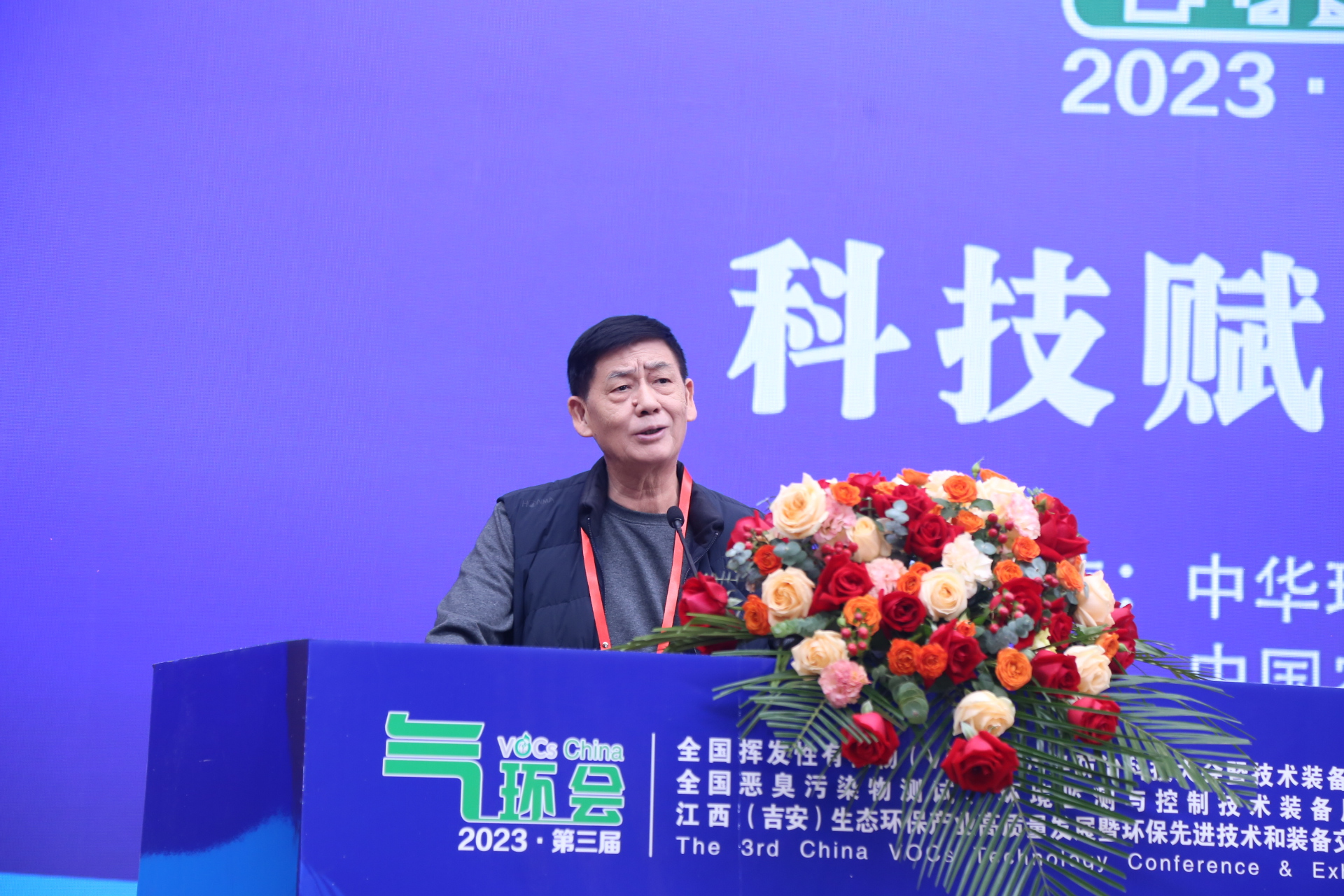
The picture shows Academician Liu Wenqing speaking at the keynote report
Air pollutant gases and greenhouse gases have the same root and origin, but the requirements for monitoring instruments are obviously different
Various components of the air, including pollutants, have their characteristic absorption spectra. Through the three-dimensional and vertical detection of pollutants by the equipment, the composition and content of pollutants at different heights on the optical path can be accurately detected, which is also the reason why optical energy provides support for environmental monitoring.
Liu Wenqing said that air pollution gases and greenhouse gases have the same root and origin, and there is significant synergy between greenhouse gas emission reduction and air pollution control measures. However, there is a big difference in the monitoring requirements of the two, which puts forward higher requirements for the research and development of monitoring instruments and technologies involved.
According to the 2022 Global Greenhouse Gas Bulletin released by the World Meteorological Organization (WMO), the concentration of major greenhouse gases in the global atmosphere in 2022 continued to break through the historical record since instrumental observations, with the concentrations of carbon dioxide, methane and nitrous oxide reaching 417.9±0.2 ppm, 1923±2 ppb, and 335.8±0.1 ppb, respectively, compared with 2021, the atmospheric carbon dioxide concentration in 2022 increased by about 2.2 ppm.
Liu Wenqing with CO2For example, due to the current atmospheric CO2The concentration is about 400 ppm, its average annual variation is about 2 ppm, and the minimum monthly variation is 0.08 ppm, which is equivalent to measuring small changes at high background values.If you want to accurately measure CO2means that the instrument's detection resolution, i.e. sensitivity, needs to be less than 0.08ppm, otherwise the measurement will be invalid。
"The spectral detection resolution requirements for polluting gases and greenhouse gases are also different, and the requirements for greenhouse gases are relatively higher. For example, for the polluting gas NO2, the instrument resolution needs to be less than 0.5nm. And against the greenhouse gas CO2The detection resolution needs to be less than 0.25nm. He said.
"Top-down" accounting of carbon emissions and carbon sinks, and calibration of "bottom-up" emission inventory
Liu Wenqing introduced the monitoring application of environmental optical stereoscopic monitoring technology in air pollution, greenhouse gases, soil environment, water environment, satellite remote sensing and other fields.
In terms of greenhouse gas monitoring, he pointed out that in order to achieve the "dual carbon" goal, it is urgent to make up for the shortcomings of greenhouse gas monitoring capacity in order to support international implementation, respond to climate change, lead global climate governance, and implement pollution reduction and carbon reduction. Among them, it includes greenhouse gas ground-based atmospheric and ecological carbon sink monitoring, ground-based and space-based remote sensing monitoring capabilities, and accelerate the establishment of carbon monitoring technology systems at different levels and scales in parks, cities, regions and the world.
He said that based on the integrated greenhouse gas monitoring capabilities of space, air and ground, combined with carbon emission inventory and carbon assimilation inversion system, it can realize the "top-down" way to calculate urban and regional carbon emissions and natural carbon sinks, calibrate the "bottom-up" carbon emission inventory, and assess the process of carbon peak and carbon neutrality.
At present, there is still no single technology that can meet the multiple requirements of greenhouse gas monitoring, and different monitoring platforms have their own advantages and disadvantages.
Liu Wenqing introduced that comprehensive field observation can understand the complex air pollution process and carry out comprehensive regional research; pollution source emission monitoring can obtain regional and industrial emission composition characteristics; long-term monitoring stations can identify the source attribution of pollution and pollution trend changes; satellite remote sensing can obtain long-distance transmission of pollution, source emissions and regional transportation status; model simulation comparison can understand the role of complex physical and chemical processes and meteorological fields, as well as their impact on air quality and global climate change.
He suggested the construction of a multi-platform smart atmospheric environment monitoring system to support the source identification and quantitative analysis of air polluting gases and greenhouse gases, and provide key support for China's green and low-carbon development.
Strengthen the integration and coordination of market, technology and policy, and promote the development of core technologies in the environmental industry
Liu Wenqing believes that during the "14th Five-Year Plan" period, environmental monitoring presents a new demand for more, more complete, more accurate, standardized, intelligent and integrated. "China's environmental monitoring has gone through the introduction, digestion, absorption, and entered the stage of re-innovation. With the improvement of environmental supervision requirements, China's environmental monitoring technology has been greatly improved in terms of remoteness, intelligence, scientific decision-making and precise supervision, which can better support the national environmental monitoring network with air, water quality and pollution source monitoring as the main body. ”
He confessed,At present, the homogenization of China's environmental monitoring products is obvious, and although important progress has been made in key materials, core components, embedded computers, operating systems, etc., there are still some core components and high-end instruments that rely on imports. At present, foreign-funded enterprises focus on the field of analytical instruments, i.e., key components, with high added value, while domestic enterprises focus on the field of instrument systems, i.e., operation and maintenance and testing services, with low added value。
"In the next 10 years, we still need more high-end equipment and high-end services. ”Liu Wenqing said that environmental technology enterprises should open up the integration path of industry and innovation, and it is the only way for enterprises to become the main body of industrial technology innovation, and at the same time, the integration of industrial demand and technological innovation still has a long way to go.
"Give more play to the role of enterprises, scientific research institutions and universities in the cultivation of cutting-edge breakthroughs and emerging industries, and seize the opportunities for industrial development. Technology, market, and policy need to be continuously integrated and coordinated. The greater the 'intersection' of the three, the more significant the role of science and technology. Liu Wenqing suggested.
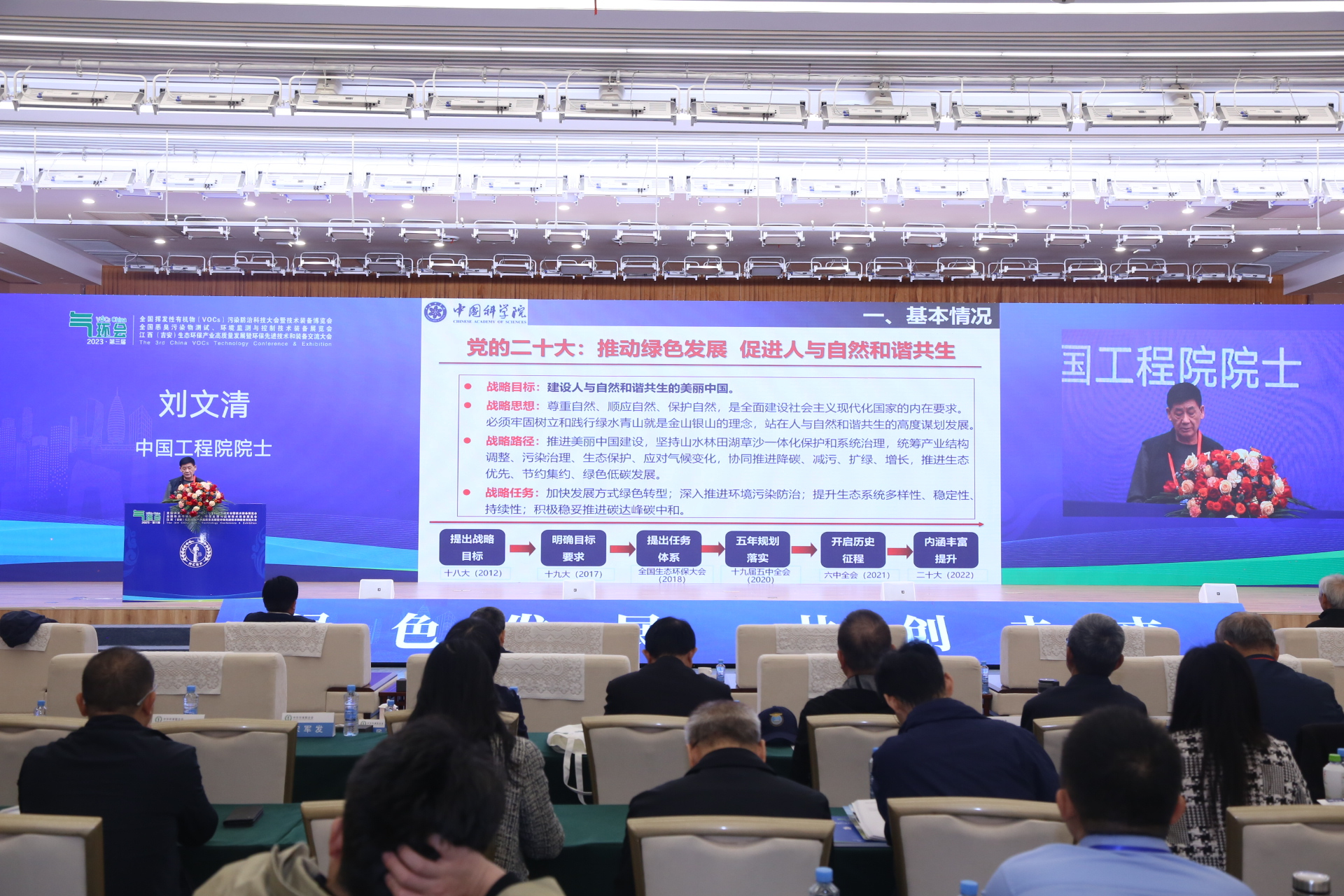
The picture shows Academician Liu Wenqing speaking at the keynote report


