


Adair Turner, Chair of the Energy Transition Commission: China and the EU should understand each other's concerns
"The West's worries about new energy are like China's worries about semiconductors. In a world where geopolitics are divided, we need to understand each other's concerns and make sure they don't get out of hand, otherwise it's certainly not good for the energy transition and bad for climate change. ”
Before China formally pledged to peak carbon emissions by 2030 and achieve carbon neutrality by 2060 in September 2020, a number of domestic and foreign institutions had already conducted research on China's emission reduction pathways. Published in November 2019, "China 2050: A Zero-Carbon Picture for a Fully Modernized Country" has had a lot of influence overseas. The report, published nearly a year before China proposed its dual carbon goals, was jointly produced by the Energy Transition Commission (ETC) and the Rocky Mountain Institute (RMI), two international NGOs focused on low-carbon energy transition, and proposed a path for China to achieve carbon neutrality by 2050.
The report assumes that China will become a moderately developed country by 2050, with a per capita GDP of 70% of that of the United States, and on this basis, predicts the carbon reduction pathways in several major sectors: industry, transportation, buildings, and energy. One of the report's researchers, the Energy Transition Commission (ETC), was founded and chaired in 2015 by Lord Adair Turner, a member of the House of Lords. Turner was the first chair of the UK government's Commission on Climate Change in 2008 from 2008 to 2012, and he was chairman of the Financial Services Authority from 2008 to 2013, when the financial crisis was in response.
After founding the Energy Transitions Council, Turner's focus shifted to climate change. He is familiar with China, having access to China's power data during a roundtable discussion at the Bund Finance Summit in Shanghai in September, and as a board member of Envision Power, a wind-starter Envision Technology Group's acquisition of Nissan's power battery business.
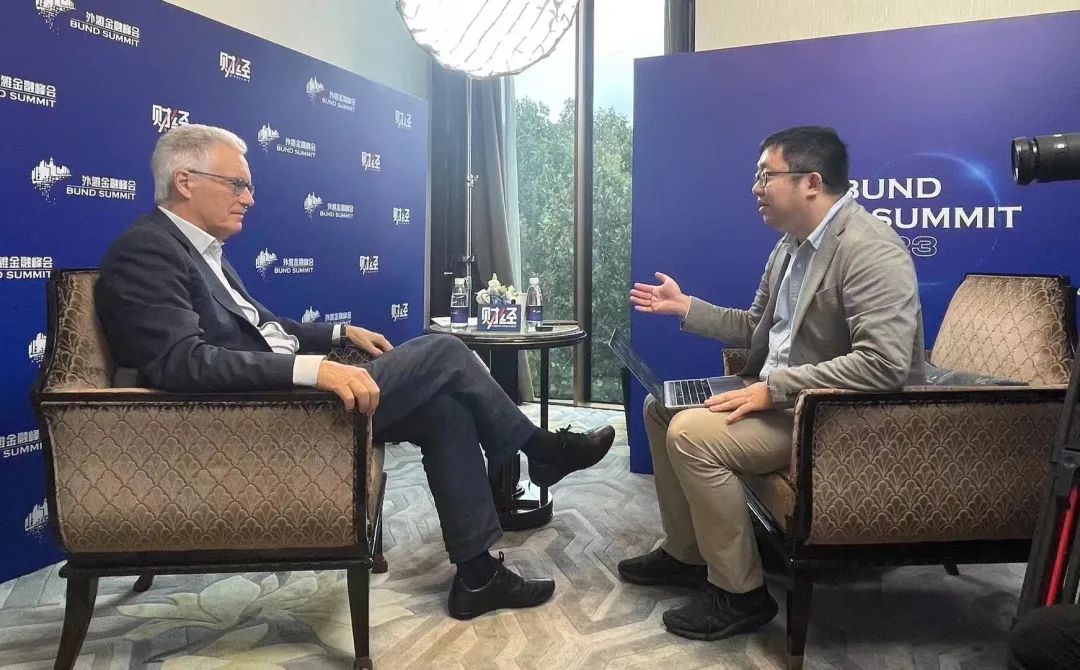
During the Bund Finance Summit, Adair Turner had a conversation with Finance Eleven on a number of hot topics. On the eve of the dialogue, British Prime Minister Sunak had just announced a series of climate policy adjustments: postponing the ban on the sale of fuel vehicles and significantly postponing the phase-out of gas boilers.
Adair Turner said in the dialogue that the energy crisis caused by the war reflects the impact of geopolitics on traditional oil and gas resources, and if an energy system of new energy and nuclear power is established in the future, all countries can better ensure energy security. In the process of transformation, the West is indeed worried about the risks caused by the huge dependence of new energy products on China, and wants to diversify the supply. This change may get out of control, and all parties need to manage the risks and not evolve into "decoupling", otherwise it will ultimately be detrimental to the energy transition.
The following is the full text of the conversation.
New energy plus nuclear power is a safer energy system
Finance ElevenIn the past two years, both Europe and the United Kingdom have faced inflation problems caused by rising energy prices and carbon prices.
Adair Turner: We must be clear that in the rise in energy prices last year, the impact of carbon prices was insignificant, mainly due to the impact of the Russia-Ukraine war and the rise in natural gas prices. Before the war, about 150 billion cubic meters of Europe's annual gas supply of about 400 billion cubic meters came from Russia, especially through the Nord Stream pipelines, and most of these imports are now gone.
In general, now Europe only imports about 200 to 25 billion cubic meters of natural gas from Russia, which is a big change, and the speed of adjustment in Europe is very prominent, there was no shortage of residential gas last winter, and the warm winter also helped. But it's true that the demand for natural gas has been greatly affected, and we have also limited the use of a lot of natural gas and diversified our sources through LNG (liquefied natural gas). In the process, the price of natural gas rose eightfold, but now the price has actually fallen to the pre-war level.
It's really putting pressure on public opinion, and some people think we can't afford the costs of tackling climate change, but I think a lot of others have the right answer:As long as you continue to import oil and gas, you are vulnerable to geopolitical changes.
And once we build a new energy system composed of wind power, photovoltaic and nuclear energy, so that the economy has the basis for electrification, we can obtain energy from our own resources, and there will be no problems like oil being affected by Middle Eastern countries and natural gas being affected by Russia.
A system of new energy plus nuclear power is fundamentally safer, for any country, for Europe, and for China. The International Energy Agency (IEA) has calculated that when we complete the energy transition, global energy trade will be reduced by 60%, and we can all become more energy independent. This is a good thing, energy trade is always a potential trigger for fragility, disputes and disagreements.
Decoupling is not conducive to the energy transition
Finance Eleven: It's an interesting question, maybe this system that relies on new energy will reduce energy trade and become more energy independent, but in this transition process, you still need to import related industries and products. And at present, in this area, trade protectionism has risen, the European Union has launched a countervailing investigation on China's electric vehicles, and the United States has introduced a bill to impose more tariffs on Chinese PV exports, what do you think?
Adair Turner: Building a new energy system is inseparable from many mineral resources, such as nickel, copper, lithium, etc. The Energy Transitions Commission (ETC) looked at the supply chain of minerals this year, and the good news is that there are abundant resources in the world, but these resources are indeed distributed in different regions, such as nickel in Indonesia and lithium in Australia, Peru, Chile, which leads to security of supply. Who has access to these resources? It makes perfect sense for Europe and the United States to consider where these resources come from.
First of all, to the extent that we can, we are developing some mine resources and refining capacity locally. Lithium resources are actually available all over the world, and lithium can be extracted from salt lakes and seawater, and the same is true for sodium. But lithium refining capacity is very concentrated, with most of it in China.
I think China, the EU, the U.S. need to have a discussion, and China needs to understand that in a geopolitically divided world, we're going to have concerns that if 70 to 90 percent of a certain resource, a product, is dependent on China, then if we have disagreements on some political issues, or if China has another lockdown, one of the lessons that we've learned from the lockdown is that if the supply chain is very centralized, there's risk.
Therefore, Europe and the United States are formulating policies to diversify supply chains and develop local supply chains. I think the key is not "decoupling",It's not that we don't buy any refined lithium products from China at all, but it's probably better to have 50% or 25% of our supply instead of 90% coming from China. For example, in the field of semiconductors, China is also worried that if there is a disagreement with the United States, the other party will not continue to sell, so China is trying to build its own semiconductor industry. So we have to accept the world as it is. But we also want to make sure that this does not become an obstacle to the energy transition, new energy vehicles and the battery industry.
China is leading the world in the development of electric vehicles, and there are many green electric vehicles on the streets of Shanghai, and the proportion of electric vehicles is very high. When I returned to London from Shanghai in May, I was walking on the streets of London, and I wondered why my city was so dirty and ugly, and the streets were full of old fuel vehicles, while Shanghai was more advanced.
China has done very well, and there are very good companies in R&D technology, and we welcome all of this, as well as Chinese products with low prices. Of course, Europe welcomes the export of some Chinese products in the past, and it also welcomes Chinese companies to set up factories in Europe, and Chinese companies are indeed doing the same.
With regard to countervailing investigations, the EU undertook to conduct a fact-finding investigation in accordance with normal procedures to determine whether there was a subsidy. I certainly hope that this will not lead to the cutting off of Chinese exports to Europe.
In fact, I think Chinese EV manufacturers make what we need: small, cheap EVs. In the West, so far EV products have been concentrated in SUVs (sport utility vehicles) and premium vehicles, which is good because it will lead to technological development. But if there is no product for the average consumer and low-income earners, it is also a problem.We need cheap, affordable electric vehicles, and Chinese automakers are much ahead of European and American automakers in this regard. So we shouldn't cut off supply, but if tariffs are raised due to the investigation, I hope that the response from Chinese automakers is to build factories in Europe.
If China were to build factories in Europe, I certainly don't think Europe would oppose it. In the UK, we have always had Japanese car companies, and a lot of the car production capacity in the UK is Nissan and Toyota, which employ British technicians, management and workers, creating added value and also creating jobs in the UK. Ideally, Chinese automakers should do the same, and they will welcome it.
We should all be mature, there are political pressures and divisions in the world, there are disputes over subsidies, and if you depend on a single country for 90% of your supply, there will inevitably be concerns.
There is a real danger that these new changes will get out of hand, but we want to make sure it doesn't get out of hand.We need to "de-risk" rather than "decouple". We don't want to decouple from China and the United States, but from a European perspective, Europe also needs to take steps to reduce the risks.
I think China also needs to be mature and confident enough to engage in it, to understand our legitimate concerns, and to make sure that it doesn't turn into a deeper "decoupling", otherwise it will certainly be detrimental to the energy transition.
China's top priority is to improve its carbon market
Finance Eleven: What advice do you have for Chinese companies and the Chinese government to deal with this "de-risking" environment?
Adair TurnerWhat China should continue to do is accelerate the energy transition. China continues to grow in photovoltaics, wind power, new energy vehicles, batteries, and will continue to be a technology leader due to China's huge domestic market and company innovation.
With regard to the trade dispute with the EU, China should be open and transparent about the economic situation, and we have WTO fact-based rules, not politics-based rules, on how to conduct investigations, and cooperation on them is likely to yield the best results.
There's one thing that you can do, and you're already starting to do, and that's something that Europe is increasingly concerned about, and that's the carbon intensity of imports. We import modules from big PV companies like Trina and Jinko to reduce the carbon emissions of the system, but if the PV modules themselves are made from coal power, this concern about carbon intensity is legitimate.
I think you're going to see more and more policies that want to know the carbon intensity of steel, photovoltaics, batteries imported from China, and about that,I strongly advise China not to boycott it, but to show that these products are okay, and that we will make sure that our steel, photovoltaic modules, batteries, electric vehicles are all made with zero carbon.Globally, I think more and more buyers and retailers will want to be able to promise consumers that the products they sell are made in a zero-carbon way.
I know a lot of Chinese companies are already thinking about this, and I highly recommend it to them, because it's important if LONGi, BYD, CATL can commit to zero-carbon manufacturing, which will remove potential risks in the trade relationship.
Finance Eleven: Can China's green electricity and green certificate trading be recognized by Europe?
Adair Turner: It's about transparency. What people want to see is the decarbonization of China's entire power system, otherwise you can play with the rules, you could say that 20% of China's electricity comes from new renewables, 80% or 70% from fossil fuels, and that 20% of renewable electricity is used to produce export goods. If it's just that, it's not really a green product.
Therefore, it needs to be more authentic and credible. If Chinese manufacturers really use renewable electricity for their own consumption, or if the purchase of green certificates is not simply a private label for existing wind and photovoltaic power, but supports the development of new wind and photovoltaic power, then this can prove that they are using zero-carbon electricity.
Also, I think it is imperative for China to build a serious carbon market. By 2032, all steel companies in Europe will face a carbon price cost, they will have to buy emission allowances for all the CO2 emitted, and if the competitor is imported steel from China without a carbon price constraint, they will be at a disadvantage, and this is the Carbon Border Adjustment Mechanism (CBAM) that Europe is discussing, which I think is completely reasonable.
China's response should be to establish a serious carbon trading system that covers all heavy industries. By 2030, the carbon price in Europe will reach about $100 per tonne, and if China does the same, we can do away with the Carbon Border Adjustment Mechanism (CBAM), because there is no need for adjustments, the EU does not want to impose these tariffs, and what the EU wants is for the rest of the world to have the same carbon pricing system as the EU.
So I think it's very important for China, not only for domestic reasons, but also to make it easier to sustain free trade on a global scale, to develop a really serious carbon pricing system.
Changes in the UK's climate policy have little impact
Finance ElevenThe UK government has recently reversed its climate change policy, delaying the ban on gasoline vehicles from 2030 to 2035, delaying the phase-out of gas boilers, and expanding the issuance of short-term allowances in the carbon market, which has led to a sharp drop in carbon prices. What do you think about these climate change policy shifts? Sunak said that this is in line with the will of the people, and is the high energy price making the British people less supportive of tackling climate change?
Adair Turner: I don't think Prime Minister Sunak understands what the British public thinks, and I don't think he'll be Prime Minister in 15 months, and he's going to lose the next election. He has not shown enough leadership on climate change, Cameron, Theresa May and Johnson have all shown that leadership, but Sunak has not done so much, and much of his approach has to do with the impact of debate within the Conservative Party.
But if you carefully analyze the changed policies, first of all, I don't worry too much about the carbon market, the reform is to increase the allowances in the short term, but eventually reduce the allowances, which has not changed the fundamentals of the UK carbon market, and it is also consistent with the trend of the EU carbon market, which has been significantly tightening allowances.
By 2030, our carbon market will cover all sectors of the economy, including electricity, heavy industry and much of the economy, with a carbon price of around £100/tonne. The price of carbon in China is likely to be £5 to £10 per tonne, which varies greatly from one market to another.
Our carbon price in 2015 and 2016 was also around £10 per tonne, and if the carbon price was only £10, it didn't mean much. If the price of carbon is £50, £60 and it is expected to rise in the future, then I am not too worried about changes in the carbon market.
Another less worrying is the postponement of the ban on the sale of gasoline vehicles. We are postponing it from 2030 to 2035, and the timetable for banning the sale of gasoline vehicles in Europe is also 2035. Prior to this change, the UK was the first country in the world to ban the sale of gasoline vehicles, and there is currently no clear timetable for banning the sale of gasoline vehicles in China, although China is the global leader in the electric vehicle industry. So this setback, while regrettable, has little impact. By 2030, all new cars sold in the UK market will also be predominantly electric, and by 2035 they will all be electric. And if Labor is in power, the government may again bring forward the ban to 2030.
The change I'm really worried about is the postponement of the phase-out of gas boilers. The UK's previous policy of using electric heat pumps for new buildings by 2026 and no longer using gas boilers has postponed this timeline to 2035, which is a very stupid change.
It's easier to install a new heat pump directly in a new building, and things should be done right in the first place. We should install the most efficient air conditioning systems in new buildings all over the world, and use heat pumps in heating systems.I hope that Labour will be able to rectify this in the future, and I know that Labour has ambitious plans to not only use zero-carbon heating systems for new buildings, but also to have policies to help retrofit existing buildings.
In general, in our system, we sometimes disagree with the government, and the government will change, but this will not change our general direction in 2030, 2035.
Finance Eleven: This is on the part of the government, but what about the people, do they still support the transition?
Adair Turner: All polls show that a majority of the population still supports climate change-related policies. There is a faction within the Conservative Party that is anti-European and a group of people who are fighting the culture wars and who do not agree to tear down statues of people who have historically made money from the slave trade, a group of people on the right. I don't think they represent the majority of the British people, but it is true that these people have a lot of influence in the Conservative Party.


