


Qingdao West Coast New Area tells the story of low-carbon development new area at the COP28 theme side event
On the evening of December 3, local time, at the China Corner of the 28th Conference of the Parties to the United Nations Framework Convention on Climate Change (COP28), a side event with the theme of "Synergy of Pollution Reduction and Carbon Reduction: Achieving a Win-Win Situation for Environment, Climate and Economic Benefits" was held. Zhou Cheng, deputy head of Qingdao West Coast New Area, shared his experience in the link of "Regional (City) Layout to Promote Pollution Reduction and Carbon Reduction".
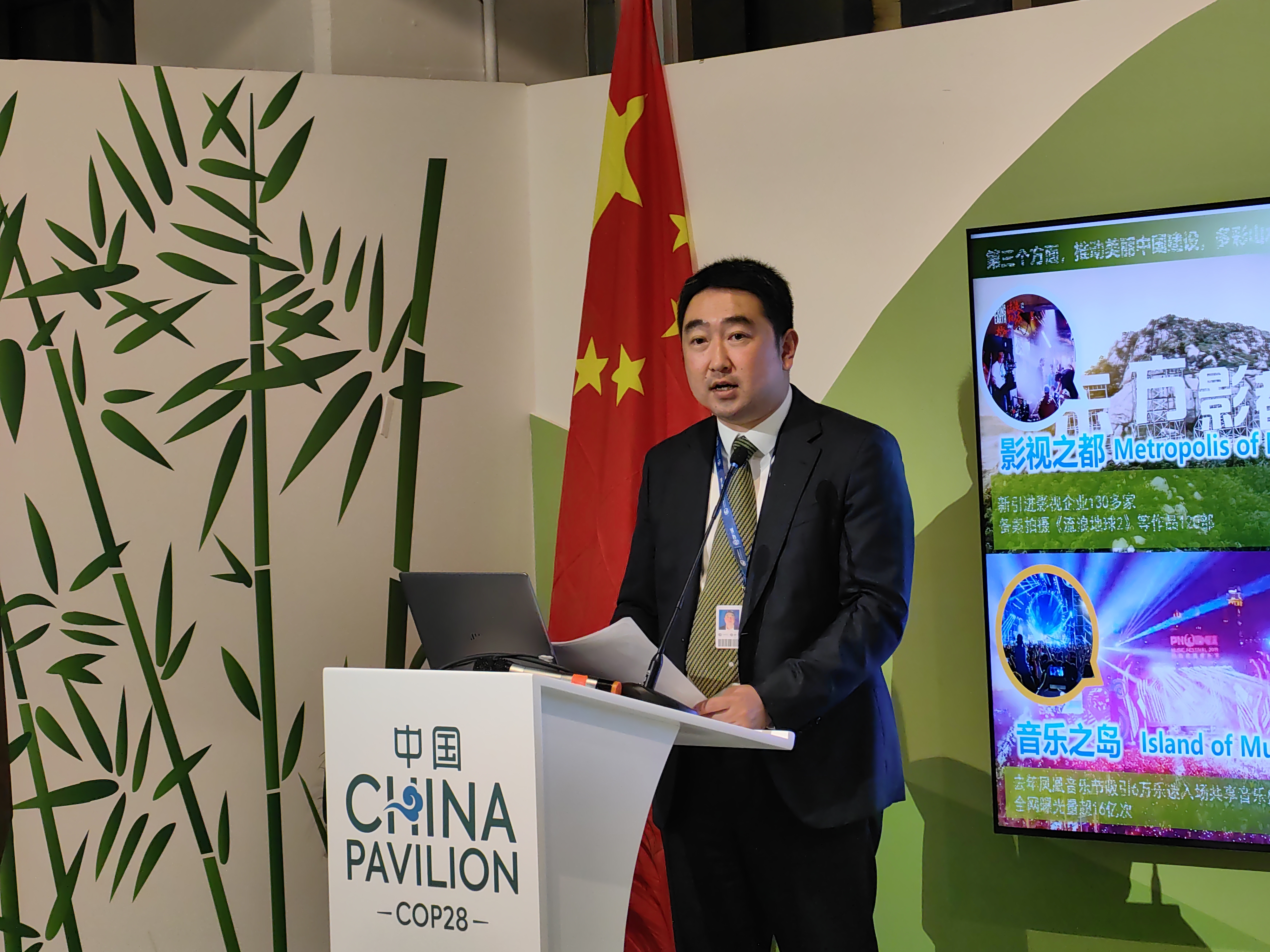
Qingdao West Coast New Area, located on the shore of the Yellow Sea and Jiaozhou Bay, is the ninth national-level new area approved by the Chinese government in June 2014. In recent years, the West Coast New Area has taken green and low-carbon as an internal requirement to promote high-quality development, focusing on planning and guidance, industrial innovation, ecological governance, ecological product value realization and other fields, integrated reform and systematic promotion, and adhering to the path of green, low-carbon and civilized development with production development, affluent life and good ecology.
In 2022, the GDP reached 469.185 billion yuan, a year-on-year increase of 4.8%, ranking third among the national-level new areas, 1.8, 0.9 and 0.9 percentage points higher than the average growth rate of the country, the province and the city, respectively, and the total economic output accounted for 31.4% of the city's total, and from January to September this year, the GDP reached 365.03 billion yuan, a year-on-year increase of 5.5%, which can be described as the "pillar" of Qingdao. In 2022, the energy consumption per unit of GDP will drop to 0.26 tons of standard coal per 10,000 yuan, a decrease of 9.72% compared with 2020. The new area adjusts and optimizes the "four structures" of industry, energy, transportation, agriculture and land use, and while resolutely curbing the blind development of high-energy-consumption, high-emission and low-level projects, it takes green and low-carbon development as a fundamental policy to solve ecological and environmental problems, vigorously cultivates green industries, develops green energy, and strengthens green support.
Establish a planning guidance system.The Shandong Provincial People's Government has issued the Three-Year Action Plan for Promoting the High-Quality Development of Qingdao West Coast New Area (2023-2025), which aims to give full play to the unique advantages of the new area as a pioneer and pilot project, accelerate the promotion of green, low-carbon and high-quality development, promote the comprehensive improvement of quality and efficiency of the new area, move to a higher level, and maintain the leading position of the West Coast New Area among national-level new areas. The New Area has formulated the "Three-Year Action Plan for Deepening the Conversion of Old and New Kinetic Energy to Promote Green, Low-Carbon and High-Quality Development" (2023-2025), the "14th Five-Year Plan for Ecological Environment", the "14th Five-Year Plan" for the Development of New Energy Industry, the "14th Five-Year Plan" for Energy Conservation and Emission Reduction, and the "Hydrogen Energy Industry Development Plan" and other guiding documents, so that green and low-carbon development can be followed.
Build a green energy system.Taking Qingdao Port, a Shandong port that ranks fourth in the world in terms of cargo throughput and fifth in the world in terms of container throughput, as an example, over the years, Qingdao Port has continued to make efforts in the construction of green ports, built the world's leading and Asia's first fully automated container terminal, and won the title of "Asia-Pacific Green Port", which is the first "double five-star" port in China.
Qingdao Port has comprehensively built a diversified new energy system covering hydrogen energy, photovoltaic and wind power, providing successful experience for the application of new energy in the world's ports. It has built the first hydrogen refueling station in a coastal port in China, the world's first "hydrogen kinetic energy" container automated rail crane, more than 10 MW of photovoltaic projects have been built and are under construction in Hong Kong, with an annual power generation capacity of more than 10 million kWh, wind power generation technology has been applied on a pilot basis, with an annual green power supply of about 1.7 million kWh, and the country's first "oil-electric hybrid" intelligent tugboat has been officially put into use, which can reduce carbon dioxide emissions by about 600 tons per year.
Promote low-carbon pilot innovation.Taking the Sino-German Ecopark, an international cooperation industrial park in the new area, as an example, it draws on the advanced experience of German ecological park construction, introduces German PHI passive house technology and DGNB sustainable construction standards, formulates localized standards based on the characteristics of Qingdao's climate zone, promotes ultra-low energy consumption buildings on a large scale, builds a zero-carbon pilot zone and a carbon-neutral lighthouse base, forms a low-carbon park construction model with industry-city integration, and explores a set of "low-carbon passwords" that can be replicated and promoted. A total of 8.35 million square meters of green buildings have been built, of which 50% are two-star or above, and 1.13 million square meters of ultra-low energy consumption buildings have been built, reducing carbon emissions by 24,500 tons annually, leading the development of passive houses in Asia. The relevant practices and experiences have been promoted by the United Nations Climate Change Conference and the 12th International Conference on Green Building and Building Energy Efficiency, and won more than 20 national honors in the field of global sustainable cities and human settlements awards and domestic smart cities. The C40 Cities Climate Leadership Alliance has released the global "Green and Prosperous Communities" guidelines, and the Sino-German Ecopark has become the only selected case in the field of green buildings and green energy in China, and has been praised by the Ministry of Commerce of China and the German Ministry of Economy as "a lighthouse project in the ecological field of the Chinese and German governments, and a model of Sino-German bilateral cooperation parks".
Lingshan Island is China's first independent "carbon-negative island", with diverse landforms and a vegetation coverage rate of 80%. In recent years, Lingshan Island has reduced carbon sources, increased carbon sinks, and achieved independent carbon negative through measures such as returning farmland to forest, household clean energy heating transformation, "zero entry into the island" of fuel vehicles, and full coverage of solar street lighting. Since the beginning of this year, Lingshan Island Provincial Nature Reserve has taken the lead in formulating the "Carbon Inclusive Incentive Mechanism Work Plan", developed a carbon inclusive platform applet, and designed a low-carbon behavior point exchange commodity activity, where citizens and tourists can exchange drinking water, special canvas bags, solar power banks and other ecological cultural and creative products in the "low-carbon store" after earning carbon credits, and guide residents and tourists to develop green and low-carbon living habits. At present, there are 24 kinds of low-carbon credit behaviors such as "taking a boat to the island", "bus travel" and "saving food" in the carbon inclusive platform applet, and citizens and tourists can upload the content and photos of their participation in energy conservation and carbon reduction actions according to different types of activities, and they can obtain points after review, so as to exchange goods in the "low-carbon store".


