


Under the price war of the lithium battery industry chain, which new technologies and materials can emerge?
Interface News Reporter | Wang Yong
In 2023, new energy vehiclesushered in a wave of price reductions。 With the intensification of competition on the sales side and the withdrawal of state subsidies, electric vehicles have to gradually transmit cost pressures to the upstream.
Lithium batteries are mainly composed of four major materials, namely cathode materials, anode materials, electrolytes and separators. In addition, there are auxiliary materials such as copper foil, aluminum foil and aluminum-plastic film.
At present, the price of many materials has also declined. According to data from Shanghai Ganglian, as of March 10, the average price per ton of ternary cathode material NCM811 was 310,000 yuan, down 21.5% from the beginning of the year, and the average price of lithium iron phosphate was 139,000 yuan/ton, down about 24% from the beginning of the year.
In terms of anode materials, on March 10, the average price of artificial graphite anode was 45,000 yuan/ton, down about one percent from the beginning of the year.
According to Shanghai Ganglian data, as of March 10, the average prices of lithium iron phosphate electrolyte and ternary conventional electrolyte were 40,000 yuan/ton and 62,000 yuan/ton respectively, down about 20% and 15% respectively from the beginning of the year.

Cost reduction and efficiency increase, material and technological innovation have become the choices that upstream enterprises have to make in response to market changes.
In this context, what new technologies or innovative products are expected to achieve a breakthrough from "0 to 1" this year?
From the perspective of the new direction of cathode materials, considering multiple factors such as energy density, cost, and safety, M3P-related materials may become a popular track in 2023.
According to the different cathode materials, lithium batteries can be divided into lithium manganese oxide batteries, lithium cobalt oxide batteries, lithium iron phosphate batteries, and ternary batteries.
Among them, lithium iron phosphate batteries and ternary batteries are the two main streams of lithium batteries. The M3P system is a new phosphate-based ternary material based on lithium iron phosphate.
The system uses the lithium iron phosphate olivine structure as the basic lattice structure, and forms a substitution at some iron element points by doping two of the metal elements such as magnesium, zinc, and aluminum, so as to generate the ternary material of the phosphate system.
At the World Power Battery Conference in July last year, Wu Kai, chief scientist of CATL (300750.SZ), said that CATL's M3P battery has been mass-produced and will be put on the market in 2023.
CATL calls it the "ternary of phosphate system", which is significantly lower in cost than high-nickel ternary, and has higher energy density, better charge/discharge capacity and cycle stability than the original lithium iron phosphate battery. Zeng Yuqun, chairman of CATL, publicly stated that the energy density of M3P battery cells has increased by 20%.
According to the capacity planning of leading battery companies, only CATL has laid out M3P batteries. However, a number of companies have laid out lithium manganese iron phosphate batteries based on lithium iron phosphate structure, such as BYD (002594.SZ), Guoxuan Hi-Tech (002074.SZ), Xinwangda (300207.SZ), EVE Lithium Energy (300014.SZ), etc.
According to incomplete statistics from interface news, upstream companies such as German Nano (300769.SZ), Dangsheng Technology (300073.SZ), and Rongbai Technology (688005.SH) have laid out cathode materials for phosphate systems.
In August last year, Qujing German Nano Technology Co., Ltd. with an annual output of 110,000 tons of new phosphate cathode material production base project entered trial production, and Dangsheng Technology and CNGR (300919.SZ) jointly planned to build 300,000 tons of phosphate cathode production capacity in Guizhou.
In 2023, anode material companies will focus on cost-reducing technology. Zhongtai Securities pointed out that the cost of graphitization accounts for about half of the processing cost of graphite anode materials, which is the core process of anode material processing and the breakthrough point of cost control.
Graphitization is the use of thermal activation to realize the orderly transformation of thermodynamically unstable carbon atoms from chaotic layer structure to graphite crystal structure. In simple terms, it is the conversion of carbon into graphite.
From the perspective of graphitization process, box furnaces and continuous graphitization furnaces will gradually rise in the future.Graphitization mainly includes batch and continuous processing technology, the batch process mainly uses Acheson furnace and internal heat series graphitization furnace, and the continuous process mainly uses continuous graphitization furnace.
According to the data of the agency, the Acheson graphitization furnace has a simple structure, sturdy and durable, easy to maintain, etc., but the effective utilization rate of energy is only about 30%, the unit power consumption is 4000-4800kWh/t, and a large amount of metallurgical coke is required as a resistance material, and the pollution is more serious; the power consumption of the inner string graphitization furnace is 20%-35% lower than that of the Acheson graphitization furnace, but it is generally only suitable for the production of electrodes, not for the negative electrode graphitization production of granular materials.
In order to further reduce energy consumption and control costs, anode enterprises have turned to new technologies, and the main directions are divided into two directions, one is the improved box furnace on the basis of the traditional Acheson furnace, and the other is the continuous graphitization furnace.
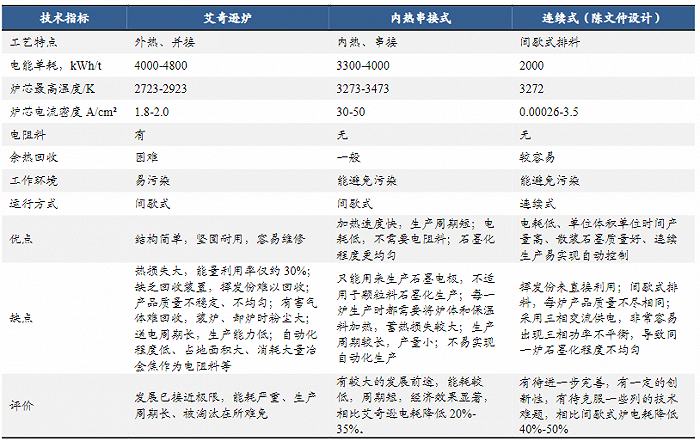
The chamber furnace is based on the Acheson graphitization furnace, and the carbon plate box is set in the furnace, and the box and materials are used to generate heat, which saves the amount of insulation resistance material and lowers the theoretical cost. According to the announcement of Putailai (603659.SH), the unit power consumption of its subsidiary's box furnace products is 40%-50% lower than that of the crucible method. However, the chamber furnace also has disadvantages, its larger chamber makes the temperature distribution in the furnace uneven, and the material uniformity is poor.


