


"Chongming Case" was unveiled at the COP28 China Corner Meeting
The 28th Conference of the Parties to the United Nations Framework Convention on Climate Change (COP28) recently opened at the Expo City in Dubai, United Arab Emirates. As the only representative of China's prefecture-level cities, Chongming District of Shanghai co-organized the conference and shared the "Chongming case" of Shanghai Chongming's construction of Chongming's world-class ecological island carbon neutrality demonstration zone during the thematic dialogue stage.
Zhang Zhitong, deputy head of Chongming District, made a special speech on behalf of Shanghai Chongming, saying that since the establishment of the ecological island positioning of Shanghai Chongming, it has strived to achieve the development goal of "harmonious coexistence between man and nature", and actively provided a vivid "Chongming case" for responding to global climate change.
Data map
With the support of the Shanghai Municipal Government, Chongming has formulated China's first regional carbon neutrality implementation plan, proposing the path and specific measures to achieve carbon neutrality from nine aspects, including new energy construction and industrial structure adjustment, and carrying out characteristic demonstrations in 10 fields such as energy, transportation and agriculture, and striving to build a high-quality carbon neutrality demonstration zone by 2050. At the same time, it took the lead in carrying out gross ecological product (GEP) accounting, established a "1+1+N" system of GEP accounting, implemented refined management of carbon emissions, and served the construction of carbon neutrality demonstration zones.
On the road of adhering to the "ecological priority and green development", Chongming District continues to explore the research and development and application of dual carbon technologies. In the eastern part of Chongming, Shanghai's first "fishery and photovoltaic complementation" demonstration project has been built, with a total installed capacity of 110 megawatts, which will be connected to the grid at full capacity by the end of 2020, with an annual power generation capacity of 140 million kWh and an annual reduction of 124,000 tons of carbon dioxide emissions.
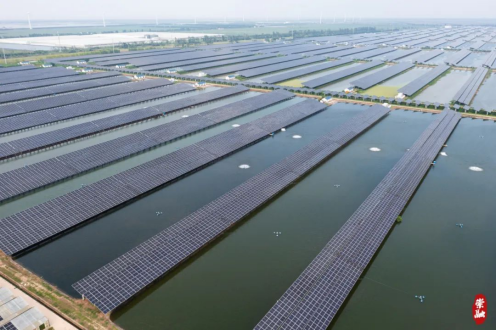
陈家镇“渔光互补”示范工程(Data map)
Chongming is also actively exploring new measures to reduce pollution and carbon emissions in the fields of construction and transportation. At the 10th China Flower Expo held in Chongming in 2021, the entire exhibition area was rated as China's first carbon-neutral park. In addition, all buses, taxis and government vehicles in Chongming have been replaced with new energy vehicles, and China's first supercapacitor new energy vehicle passenger ferry designed and built by itself has also been put into use.
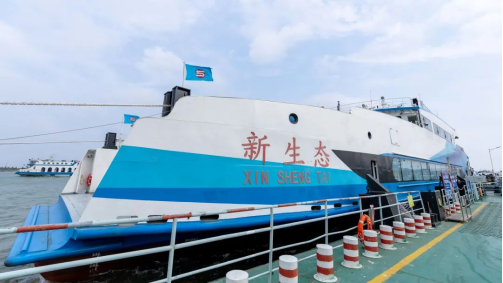
国内首艘超级电容新能源车客渡船(Data map)
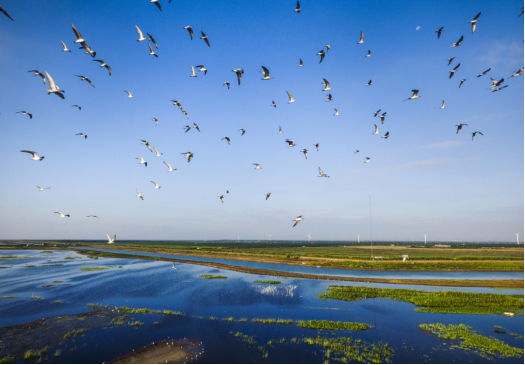
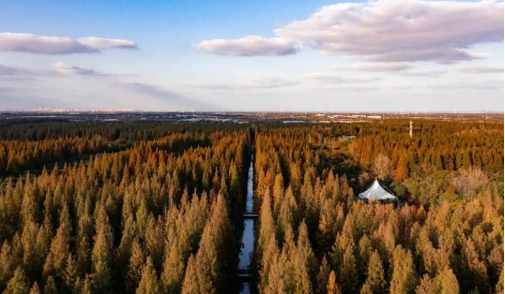
Over the past 20 years since the construction of the eco-island, Chongming has always been committed to ecological construction and environmental protection, and has continued to carry out water, soil, forestry and gas environmental management, with a cumulative investment of nearly 20 billion US dollars. In recent years, Chongming has continued to promote large-scale afforestation, and the total forest area has reached 359 square kilometers, accounting for nearly one-third of the total forest area in Shanghai. Chongming also has abundant wetland resources, with a total wetland area of 2,642 square kilometers, and is actively creating an international wetland city, taking this opportunity to continue to strengthen the protection and restoration of coastal wetlands and enhance the potential of blue carbon. In the "Yangtze River Protection" strategy, Chongming has implemented policies such as a 10-year ban on fishing on the Yangtze River and the return of beaches to the river, and in 2018, the entire area of Chongming was designated as a wildlife hunting area.
Data map
Through government guidance and public participation, Chongming vigorously promotes green production and lifestyle. In Chongming's rural areas, solar photovoltaic panels have been installed on the roofs of many houses to convert solar energy into electricity, reducing carbon emissions, and the excess electricity can also be integrated into the grid, allowing farmers to reap energy benefits. A total of 5,548 photovoltaic panels have been installed on the roofs of 88 residential buildings in Shanghai's largest rural community, with an estimated annual power generation of 2.83 million kilowatt hours. In addition, Chongming has also achieved full coverage of domestic waste classification and treatment, with a resource recycling rate of 42.1%, a comprehensive utilization rate of crop straw of 98.1%, and a recycling rate of pesticide packaging waste of 100%.
As the area with the best water quality, the best air quality, the widest forest area and the richest biodiversity in Shanghai, Chongming's case sharing tells the world the "Chinese story" of Xi Jinping's ecological civilization thought, and also provides the "Chinese experience" for the world to respond to climate change.


