


Carbon science popularization: the improvement of carbon and electricity linkage and green trading mechanism
With the release of the new Green Certificates Deal and the upcoming relaunch of CCER (China Certified Voluntary Emission Reductions), China's green trading mechanism has embarked on a new stage of reform and improvement.
Green certificates represent the environmental attributes of green electricity, and the CCER mechanism realizes carbon emission reductions, both of which are the subject of environmental rights and interests, with common goals, but also conflicts and overlapping parts.
In addition to green certificates and CCER, the green trading mechanism also includes green power trading, carbon market, and emission rights trading, all of which aim to promote low-carbon green transformation in a market-oriented manner. In the process of strategic transformation from dual control of energy consumption to dual control of carbon emissions, the relationship between carbon and electricity in the green trading mechanism urgently needs to be straightened out.
From the power generation side, the essence of carbon-power linkage is to transmit the cost of carbon emissions to the price of electricity. In the future, if carbon quotas are tightened and carbon prices rise, the weight of carbon emission costs in the cost of thermal power will increase, and the need for carbon prices to be transmitted to electricity prices will increase. A number of industry insiders told Caijing Eleven that the transmission of carbon prices to electricity prices cannot be forced to be linked administratively, but should be based on a completely market-oriented electricity market and freely linked in a market-oriented manner.
For the electricity consumption side, that is, electricity consumers, the main expectations for achieving carbon-electricity linkage are: Enterprises included in the carbon market control will deduct the green electricity purchased from their total electricity consumption when accounting for their indirect carbon emissions, so as to reduce indirect carbon emissions. The three regional carbon markets in Beijing, Tianjin and Shanghai have issued such policies, while the national carbon markets have not yet formulated relevant policies.
At present, China's electricity market reform is entering the deep water area, and the construction of a unified national electricity market and spot market will help achieve more efficient carbon and electricity linkage on the power generation side in the future, but this still requires steady progress in reform. At the same time, after the expansion of the national carbon market, the policy of offsetting carbon emissions by green power is expected to be extended from the regional carbon market to the national carbon market.
Carbon-electricity linkage on the electricity side: green electricity offsets indirect carbon emissions
At present, the linkage of carbon and electricity on the electricity consumption side is essentially the linkage between green electricity and the carbon market.
Since 2023, the three regional carbon markets of Beijing, Tianjin and Shanghai have successively introduced policies for zero carbon emissions of green electricity. The national carbon market has not yet been implemented, but after the expansion of the national carbon market, this policy is imperative.
Corporate carbon emission accounting includes two categories: direct carbon emissions and indirect carbon emissions: direct emissions refer to carbon dioxide emissions generated by the use of fossil energy such as coal, natural gas, and oil; indirect emissions refer to carbon dioxide emissions generated by purchased electricity and heat.
China's regional carbon market and national carbon market include direct and indirect carbon emissions, which is the basis for carbon-electricity linkage. The three regional carbon markets that have introduced carbon-electricity linkage policies have certain differences in the specific implementation, and in general, indirect carbon emissions are calculated after deducting green electricity, and consumption certificates such as green certificates are required.
Green certificate is renewable energy green electricity certificate, a green certificate corresponds to 1000 degrees of renewable energy electricity. China's green certificates can be traded in the form of "integration of certificates and electricity" or "separation of certificates and electricity". The former refers to the bundle of electrical energy value and environmental value transactions, and the buyer owns both the electrical energy and its environmental value; the latter refers to the sale of electricity and environmental value separately, and the buyer owns one. In addition to voluntary subscription, green power and green certificate trading is mainly organized by the two major trading centers in Beijing and Guangzhou, and "securities and electricity in one" transactions are the mainstream.
At present, green certificates and green electricity trading are not active. Enterprises that purchase green electricity certificates are mainly voluntary, meet supply chain requirements or export-oriented enterprises, and their constraints come from their own emission reduction targets or emission reduction constraints of target markets and customers, and do not have mandatory attributes. According to statistics from the China Electricity Union, From January to July 2023, all power trading centers across the country completed a total of 3,191.31 billion kWh of market transactions, of which 25.57 billion kWh were traded in green power, accounting for 0.8%. The trading volume of green certificates is much less than the trading volume of green electricity.
Only by combining the mandatory attributes of the carbon market or quota system can the demand for green power rise sharply and further promote the rapid development of renewable energy. On August 3, 2023, when the three departments jointly issued the new green certificate policy, they said that they should study and promote the connection and coordination between the green certificate and the national carbon emission trading mechanism and the greenhouse gas voluntary emission reduction trading mechanism, so as to better play the synergy of the system.
The national carbon market currently includes only one sector: thermal power. Compared with their direct carbon emissions, thermal power enterprises purchase very little electricity, and whether or not green power is deducted has little impact on their carbon emission accounting. After the expansion of the national carbon market, most of the other emission control industries have higher electricity demand, and the demand for carbon-power linkage is more urgent.
According to a report by China Innovation Carbon Investment, a comprehensive carbon neutrality service provider, the draft carbon emission accounting standards for the cement and electrolytic aluminum industries released in 2021 had made it clear that waste heat and green electricity should be deducted when calculating indirect emissions from purchased electricity. When the national carbon market includes the cement and electrolytic aluminum industries in the control, the proportion of indirect emissions will account for about 20%, and the demand for control enterprises to use green electricity to reduce carbon emissions is more prominent.
The carbon market is a stick imposed on high-emitting companies, and green certificates are a carrot for zero-carbon renewable energy companies. "To give the battered companies the opportunity to take carrots. Qin Yan, chief power and carbon analyst at the London Stock Exchange and researcher at the Oxford Energy Institute, told Financial Eleven that the connection between the two is very necessary.
Compared with the national carbon market, the regional carbon market covers more fields, and some control industries have as many as a dozen. In addition to the green power deduction policies issued by the above three places, it is expected that more regional pilot carbon markets will follow up with the green power deduction policies.
Guangdong is one of the largest green power trading pilots in the market, and the annual trading volume and transaction amount of the Guangzhou regional carbon market rank first in the country. Guangzhou has begun to explore carbon and electricity linkage.
Guangzhou Electric Power Trading Center and Nangrid Carbon Asset Company jointly built a "user electricity carbon accounting assessment" model to accurately calculate carbon emissions for enterprises. The operation of the system first identifies and decomposes its electricity consumption according to the enterprise's power trading contract, and obtains the electricity consumption of various types of power sources (water, coal, gas, wind, solar, and nuclear). Then, the carbon emissions of its electricity consumption are calculated by the carbon emission factor of its power plant during the power trading contract period, as well as the carbon emission factor of the power grid of the company's own province and region. The third step is to calculate the carbon emissions contained in the use of environmental rights products to offset the company's electricity consumption. Finally, the accounting is completed and the user's electricity carbon accounting report is issued.
The person in charge of the above-mentioned project of the Guangzhou Electric Power Trading Center told Caijing Eleven that when the national carbon market is about to expand, there are strong calls from all walks of life for the introduction of green power deduction policies. There should be an information-sharing platform between green power and carbon to more accurately calculate corporate carbon emissions. If you manually report and verify the green certificate information one by one, the efficiency will be very low.
It is worth noting that for emission control enterprises included in the carbon market, the purchase of green electricity can offset part of the indirect carbon emissions, and they also need to pay the corresponding green power premium. Therefore, for energy-using enterprises included in the coverage of the carbon market, When the green trading mechanism is mature, different emission control methods can be selected according to the specific price of carbon price and green power premium: whether to pay the carbon price of carbon allowances, purchase CCER, purchase green electricity, or internal technological transformation to reduce carbon.
Carbon-electricity linkage on the power generation side: Carbon prices affect electricity prices
Another form of carbon-electricity linkage is that on the basis of mature electricity markets and carbon markets, carbon price transmission becomes the power generation cost of fossil energy, thereby affecting its quotation in the power market, making carbon emission power varieties bear higher costs and promoting the transformation of the power generation side.
The EU is the region with the most mature carbon and electricity linkage mechanism on the power generation side, and its perfect electricity market and carbon market are the basis for carbon prices to influence the quotation of different power sources and guide the clean transformation of power generation. It has effectively promoted the fuel switch on the power generation side of Europe, allowing gas and electricity with lower carbon emissions to replace coal power.
There are two major supports behind the successful implementation of this linkage mechanism, one is that the carbon market affects the carbon emission costs of different generator sets, and on the other hand, the electricity market clearing mechanism with marginal cost pricing puts units with higher carbon emission costs at a disadvantage.
Specifically, In the EU's electricity market, the cost of a generator set is mainly composed of fuel costs, carbon costs and operating costs. The power generation cost of gas and coal power is mainly affected by fuel cost and carbon cost, while new energy and nuclear power generation do not produce carbon emissions, carbon cost is 0, new energy depends on the sky, there is no fuel cost, only variable operating costs. As shown in the figure below, the European Commission's "European Electricity Market Clearing Order and Price Dynamics Report" data shows that in 2022, because the energy crisis mainly affects natural gas prices, the fuel cost of gas and electricity is the most affected, its power generation cost is the highest, and the carbon cost of coal power is the highest.
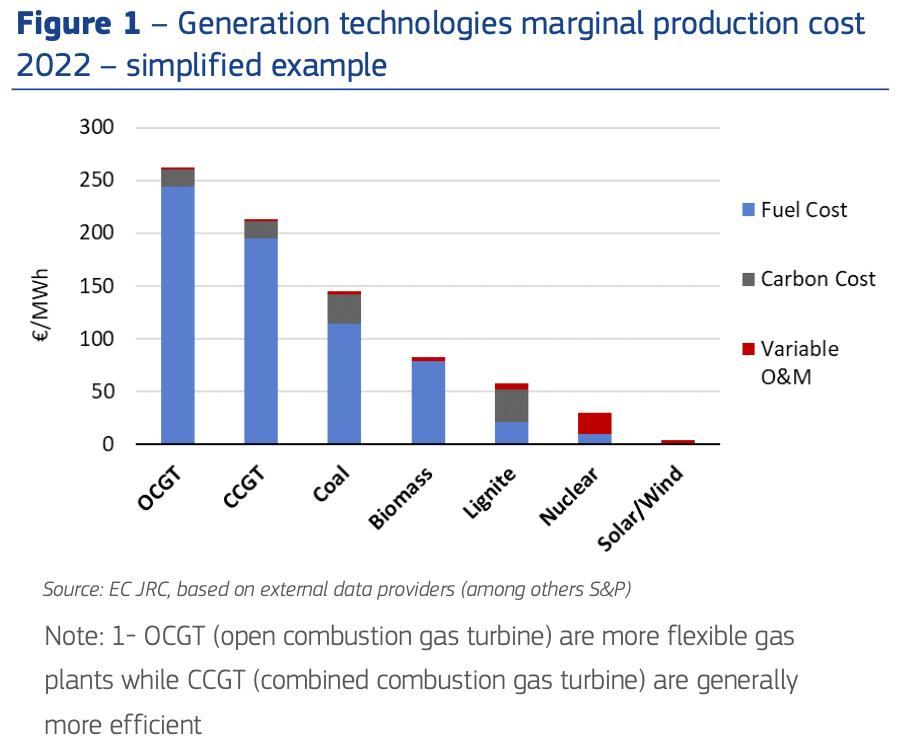
Figure: Marginal cost composition of different units in Europe in 2022 Source: European Joint Research Centre (EC JRC)
The cost of different power supplies is different, which determines its quotation strategy in the electricity market. In the marginal clearing electricity spot market, the quotation of the last unit that meets the system balance determines the clearing price of the entire power market, and the generator set quotation needs to consider the comprehensive consideration of carbon price, fuel cost and variable operating expenses to quote.
Then, if the balance of supply and demand of the power system cannot be met by new energy output alone, the marginal unit will be a gas-electric or coal-fired power unit, and its quotation will inevitably include the carbon cost, and the quotation of the marginal unit is the clearing price of the entire market, and the carbon cost of the power generation side is therefore transmitted to the entire market through the electricity market. And if the wind and sunshine are prosperous, the new energy alone can meet the system balance, and the new energy will become the marginal unit of the market, and its clearing price is lower and does not include carbon costs.
Europe's carbon market only calculates direct carbon emissions from emission control companies, not indirect carbon emissions from purchased electricity. In China's regional carbon market, indirect carbon emissions from electricity purchased by emission control enterprises are almost always included.
In 2022, due to the impact of the energy crisis, the price of natural gas has risen, driving up the cost of gas and electricity. In 2022, France's nuclear power will be overhauled on a large scale, with insufficient water supply and new energy supply, resulting in gas and electricity becoming marginal units in the market for many periods. According to the report of the Joint Research Centre of the European Commission, in 2022, 55% of the time electricity market clearance prices were determined by gas and electricity, which also pushed up the price of electricity in the EU. However, due to different installed capacity structures in different countries, the wholesale electricity price of Italy, which has a high proportion of gas and electricity, is the highest in most of the time, while the wholesale electricity price of Sweden, which is rich in nuclear power and renewable energy, is lower than that of other EU countries most of the time.
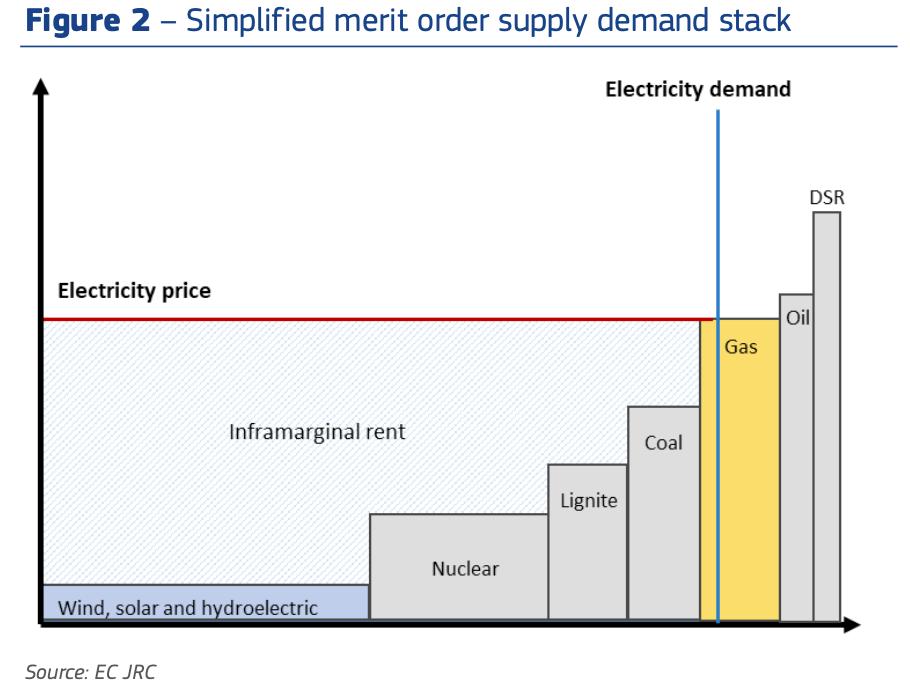
Figure: Schematic diagram of the European electricity market clearing mechanism, gas and electricity will be marginal units for most of 2022 Source: European Commission Joint Research Centre (EC JRC)
Qin Yan introduced, The market electricity price in EU countries is determined by the cost of marginal power supply, and if the marginal unit is a thermal power unit, then its quotation includes the cost of carbon price. The EU carbon price is uniform, but the power structure of different countries is different, so the proportion of carbon price cost to electricity price is also different. According to the current level of the EU carbon price of 85 euros a tonne, Eastern European countries with a high proportion of thermal power, the average cost per MWh of electricity including carbon price is 70 to 80 euros (the current exchange rate is about 0.55-0.63 yuan / kWh); the Nordic countries with a high proportion of renewables have a lower carbon price cost, with an average of 20-30 euros per MWh (about 0.16-0.23 yuan / kWh). As a result, the outlook for thermal power asset returns by power generation companies is becoming increasingly pessimistic, and investment in zero-carbon renewable energy generation is incentivized.
It should be pointed out that The clearing price of the electricity market is the price of the wholesale side, while the electricity fee paid by the electricity user side also needs to add taxes and renewable energy subsidies to the market clearing price. In the past, consumer-shared renewable energy subsidies promoted the development of new energy in Europe, but now there is a new trend for electricity users to sign long-term direct power purchase agreements (PPAs) with new energy developers, which help new energy developers finance the development of new energy and help users secure green power sources on the other.
In China, both the electricity spot market and the national unified electricity market are in progress. With the improvement of the marketization of electricity trading in China and the gradual improvement of the carbon market, the linkage between electricity and carbon that directly transmits carbon prices to electricity prices will also be achieved.
In the future, the carbon market and the electricity market will be like the relationship between coal and coal power industries. The coal-power linkage policy, once the most important policy in the coal power industry, was introduced at the end of 2004, that is, the electricity price was adjusted accordingly according to the fluctuation of coal prices. On January 1, 2020, since market-based trading has accounted for about 50% of electricity, the coal-power linkage mechanism has been abolished, and the electricity price pricing mechanism has been changed to "benchmark price + 10% up and down".
After entering 2021, coal prices unexpectedly entered an upward channel, and the pricing mechanism at that time caused coal power companies to generally suffer serious losses and even a power gap. Therefore, in 2022, it will be reformed again, and the coal-fired on-grid tariff will be adjusted to "benchmark price + 20% up and down". At the same time, high-energy-consuming industries are formed by market transactions, and are not subject to the 20% increase.
Guo Wei, general manager of China Innovation Carbon Investment, a comprehensive carbon neutral service provider, told Caijing Eleven that carbon and electricity linkage can refer to the experience of coal-power linkage policies, and instead of implementing mandatory linkage by administrative order, it should play more of the role of the invisible hand of the market, so that power generation enterprises can transmit carbon emission costs to downstream through the electricity market, and let electricity prices and carbon prices be linked through market-oriented methods.
The market-oriented reform of China's power industry began in 2002 with the Notice on Printing and Distributing the Reform Plan for the Electricity System (Document No. 5). The "Several Opinions on Further Deepening the Reform of the Electric Power System" (Document No. 9) issued in 2015 has further promoted reform, and the degree of marketization of electricity trading has been continuously improved. Between 2017 and 2022, the nationwide market-oriented trading electricity (including intra-provincial and inter-provincial electricity) increased from 1,632.4 billion kWh to 5,254.3 billion kWh, accounting for 25.9% to 60.8% of the total electricity consumption.
The carbon price directly affects the carbon and electricity linkage of the electricity price, which actually increases the power generation cost of thermal power, making it face higher cost pressure in the power market, so that new energy with lower marginal cost and fuel cost can give priority to power generation.
Zheng Ying, a special invited researcher of the China Carbon Neutrality 50 Forum and director of the Beijing Power Chain Technology Dual Carbon Business Department, told Caijing Eleven that in the process of building a new power system, with the increasing proportion of renewable energy generation, it is becoming more and more important to guide consumers to consume renewable energy electricity by market-oriented means. However, if there is no price transmission mechanism between thermal power prices and carbon prices, the carbon emission cost of thermal power cannot be borne by the whole society, which is not conducive to guiding the consumption of renewable energy electricity on the user side, and on the other hand, thermal power enterprises are also difficult to sustain.
As for the definition of a new power system, the second meeting of the Central Committee for Comprehensive Deepening Reform in July 2023 clearly stated that it is necessary to accelerate the construction of a "clean, low-carbon, safe and abundant, cost-effective, supply and demand coordination, flexible and intelligent new power system".
The proportion of renewable energy generation in China is gradually increasing. According to statistics from the China Electricity Union, in 2022, the country's non-fossil energy power generation will be 3,144.3 billion kWh, an increase of 8.6% over the previous year, accounting for 36.2% of the total power generation, an increase of 1.7 percentage points over the previous year.
If power generation companies transmit the rising carbon price to the price of electricity, electricity users, especially large electricity users, may be under pressure from higher electricity costs. "At this stage, China is in a critical stage of post-epidemic economic recovery, in order to support industrial development and stimulate investment by related enterprises, local governments are actively studying measures to stabilize electricity prices, and electricity prices are less likely to be affected by carbon prices for a period of time. Zheng Ying said.
From the perspective of the development stage of the electricity market, it will take some time to realize the carbon-electricity linkage on the power generation side. Domestic electricity trading is still dominated by medium and long-term electricity trading, there are still barriers to inter-provincial trading, the construction of cross-provincial and cross-regional electricity spot markets still has a long road, and the road to marketization of electricity trading is still long.
How to improve the green trading mechanism
The EU's green trading mechanism is centered on a highly market-oriented carbon market and electricity market. In China, green certificates will play a bridging role to promote the synergistic development of the electricity market and the carbon market.
On August 3, 2023, the National Development and Reform Commission, the Ministry of Finance and the National Energy Administration jointly issued a new green certificate policy, which expanded the scope of green certificate issuance to all renewable energy electricity. meantime The green certificate is clearly regarded as the only proof of the environmental attributes of renewable energy electricity in China, and the only certificate for determining the production and consumption of renewable energy.
This new policy has improved the standards and specifications for green certificate trading, but it is still in the embryonic stage of market trading. The other trading targets in the green trading system are also in the early stage of marketization and are relatively fragmented, and it is urgent to clarify policies and coordinate development.
Zou Ji, CEO and president of Energy Foundation China, told Caijing Eleven that China has made it clear in its development strategy that environmental factors are allocated in the market. However, in reality, there are many transaction targets, and some overlap, which will bring many adverse effects, such as double counting of environmental rights. At this stage, a variety of green trading mechanisms are in a state of eight immortals crossing the sea, and different market mechanisms also need to be coordinated from the top-level design.
Zou Ji said that whether it is a green certificate, CCER, or the carbon market, the current trading volume is not large, and there is less linkage. How to coordinate these mechanisms, the debate in the industry is basically still in the theoretical stage. Air-to-air discussions will never lead to conclusions, and only after the problems are exposed in practice is the opportunity to truly solve the problems. Therefore, at this stage, we should advocate more practice from all parties and not be afraid of exposing problems.
Avoiding double counting is the most urgent issue in the green trading mechanism, especially the overlap between green certificates and CCER. According to the existing policy, some renewable energy projects can apply for both green certificates and CCER.
According to the Industrial Securities Institute of Economics and Finance, the CCER projects currently filed and recorded in China are mainly renewable energy, accounting for more than 75%, mainly including wind power and photovoltaic, waste incineration power generation, hydropower, biomass energy, etc.
Which projects are included in the restarted CCER will be determined by the new methodology (i.e. a set of criteria for judging whether and by how much a project is reduced). The Ministry of Ecology and Environment has solicited hundreds of methodologies, and which new methodologies to use in the future have not yet been released.
The coordination and connection of different emission reduction mechanisms is inseparable from the clarification of management rights and responsibilities and mutual cooperation between the competent authorities. At present, electricity trading and green power and green certificate trading are mainly promoted by the National Development and Reform Commission and organized and implemented in the power trading center. The carbon market and CCER are under the supervision of the Ministry of Ecology and Environment and are organized and implemented on the environmental exchange.
Some companies that own both thermal power and renewable energy generation assets have set up green power, green certificates, carbon allowances and CCER trading management in one institution to maximize the value of green trading. Huang Junling, director of the international clean energy research office of China Three Gorges Corporation, told Caijing Eleven that only by establishing an open and transparent market can companies make better decisions when they choose trading targets with different environmental attributes. If you compare the price of green certificates and CCER, you have to find several departments and multiple enterprises, and the efficiency cannot be high.
At present, the relative prices of green certificates and CCER carbon reduction are relatively close. According to the Institute of Economics and Finance of Industrial Securities, a green certificate represents 1,000 kWh of renewable energy, and a green certificate deducts an average of 0.5703 tons of carbon emissions. According to the price estimate of the green certificate subscription platform, the cost of using green certificate to reduce carbon emissions is about 69.26 yuan/ton to 70.14 yuan/ton. For CCER, according to the Fudan Carbon Price Index, the median price of CCER used in the national carbon market in August 2023 was 56.70 yuan/ton. Considering that the current exchange volume of CCER is very small, there is a certain difference between the actual project transaction price and carbon price of each pilot exchange, so the actual carbon reduction cost of using CCER and using green certificates is not much different.
Policy uncertainty will affect the circulation of various green trading targets. The person in charge of the above-mentioned "user electricity carbon accounting assessment" project said that some market entities have received feedback that the policy is not yet clear, if the environmental attributes of green electricity are transferred from the location of the power source to the green power buyer, should the local government also remove these green electricity accordingly when calculating the green power consumption index of the regional power grid?
In the future green trading mechanism, carbon-electricity linkage will also be extended to carbon-energy linkage, allocating all environmental rights and interests in a market-oriented way to help implement the "dual carbon" goal.
This article is from the WeChat public account"Financial Eleven" (ID: caijingEleven)Author:Xu Peiyu Han Shulin, 36Kr published with permission.


