


Interview with Mao Tao, Center for International Economic and Technical Cooperation of the Ministry of Industry and Information Technology: The construction of green supply chains by large enterprises can drive small and medium-sized enterprises to "go gr
October 19,According to the report released by the Institute for Public and Environmental Studies (IPE) at the 2023 Green Supply Chain and Climate Action Forum, under the guidance of environmental information disclosure, important progress has been made in the construction of green supply chains in China in the past decade, providing positive assistance for China's environmental governance and global climate action.
Looking forward to the next decade, IPE analyzes relevant national documents and proposes that green supply chain management is expected to become an important starting point for China's industrial sector to coordinate the implementation of carbon neutrality goals and coordinated carbon reduction and pollution reduction.
Focusing on the theme of China's green supply chain construction, the reporter of "Daily Economic News" (hereinafter referred to as NBD) interviewedMao Tao, Director of the International Cooperation Division of the Center for International Economic and Technical Cooperation of the Ministry of Industry and Information Technology.
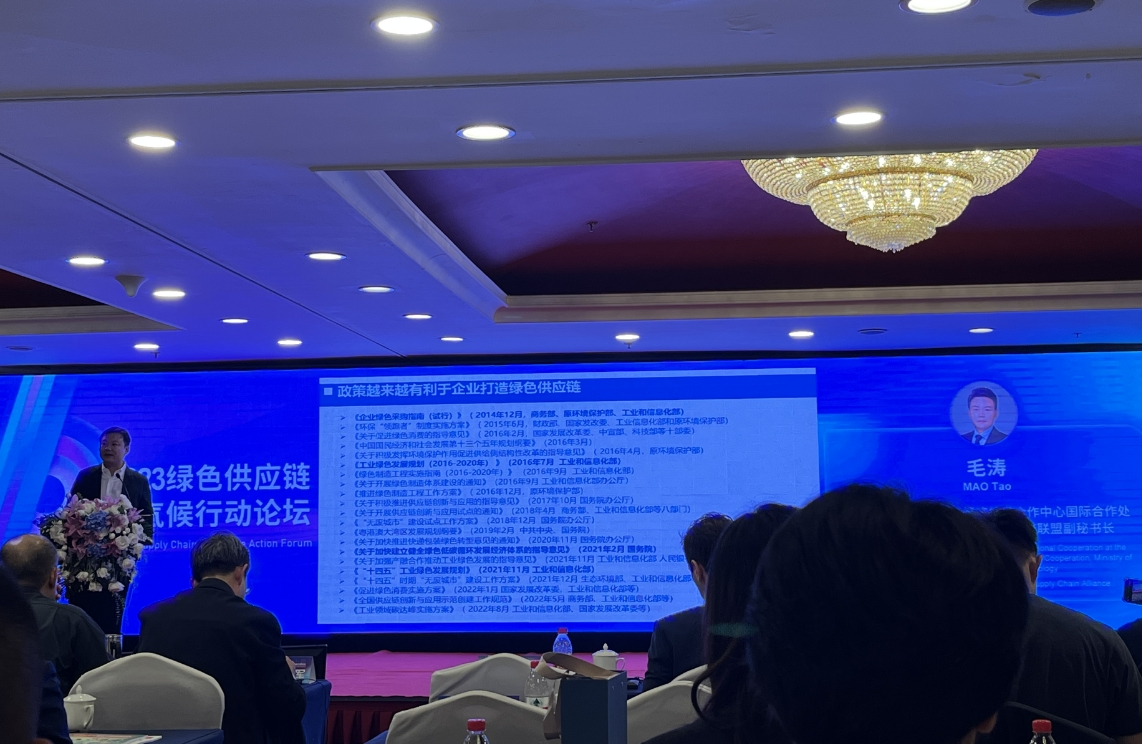
Mao Tao, Director of the International Cooperation Division of the International Economic and Technical Cooperation Center of the Ministry of Industry and Information Technology, spoke at the forum Photo source: Shi Yuxin, an intern reporter
Procurement is the key link in the construction of green supply chain
NBD:In the process of green supply chain construction, procurement, production, logistics, design and other links will be involved, which link do you think is the most important? What are the difficulties?
Mao Tao:In the process of green supply chain construction, procurement is the most important, and the power of procurement can promote upstream suppliers to achieve green environmental protection. The difficulty is that only if the purchase volume is large enough, it has a certain right to speak, otherwise it is difficult to influence suppliers. Green procurement by enterprises will also increase some costs, and how to smooth the costs through taxes or other incentive policies in the end market is very critical.
NBD:At present, what policies and measures can we have to reduce the procurement cost of enterprises and promote the construction of a green supply chain?
Mao Tao:For enterprises that become national green supply chain demonstrations, some provinces and cities will give certain incentives.
NBD:Different places have different incentives and incentives for the construction of green supply chains, will this lead to inconsistency in the pace of emission reduction in different places?
Mao Tao:This is normal, in the more developed areas in the east, environmental protection standards will be higher, enterprises also attach more importance to the concept of green development, and local rewards are more. At present, the attention to environmental protection in the central and western regions is gradually increasing, and environmental protection law enforcement is also very strict, which will also urge enterprises to transform green.
Green supply chain construction is not only a practical demand for enterprises, but also a social responsibility. On the one hand, some enterprises may encounter "green barriers" when exporting products, requiring product carbon footprint certification; On the other hand, it is also related to the construction of corporate brand reputation.
Pay attention to the green and coordinated development of large and small enterprises
NBD:In the context of carbon neutrality, what is the significance of China's green supply chain construction?
Mao Tao:The significance is very large. The enterprises that enter the carbon market now are actually enterprises that have reached a certain threshold of carbon emissions, which can also be understood as large enterprises. Small and medium-sized enterprises are less concerned about carbon neutrality or carbon emissions, and many are growing enterprises, which may be more concerned about economic benefits.
However, a large number of small and medium-sized enterprises are at the upper end of the supply chain, and there are many supporting enterprises, so if large enterprises put forward carbon emission reduction requirements in the supply chain, they can drive small and medium-sized enterprises to participate together.
The number of small and medium-sized enterprises is very large, although each enterprise has limited space to reduce emissions, but the total carbon emission reduction of so many small and medium-sized enterprises together is not small. Some large enterprises have done a good job in this regard, will train upstream suppliers, help them build capacity together, and will also go to the site for guidance. The spillover effect of these upstream suppliers' improvements is very large. For example, if a large enterprise instructs its upstream suppliers to do a good job in carbon emission reduction, then other companies purchase the products of this supplier, which is also a green product. Large enterprises not only drive one supply chain "green", but also drive other supply chains to "green".
At present, many Chinese enterprises have begun to pay attention to green supply chain management, through which the environmental performance of the entire supply chain continues to improve and improve.
In foreign countries, the zero-carbon supply chain goal of enterprises is a trend, and Chinese enterprises should learn from it, but the carbon neutrality goal of the supply chain should be designed rationally, not only in combination with the development trend of domestic and foreign policies, but also in combination with the actual development of enterprises, and gradually reduce the carbon emissions of the supply chain in the development process.
NBD:In this case, how should Chinese companies respond?
Mao Tao:On the one hand, we should pay attention to the changes in some international policies and decrees, which have a greater impact on end products. Enterprises should also pay attention to the dynamics of foreign counterparts, especially leading enterprises, to obtain the requirements and standards for green products in different countries.
On the other hand, the government should encourage and guide enterprises to strengthen green supply chain management. For example, now environmental management has gradually changed from a single enterprise to the management of the entire product supply chain and life cycle, paying more attention to the green coordinated development of large and small enterprises, and ultimately encouraging the production of truly green products.
Cover image source: Visual China VCG21400233878


