


The report "China's Practical Actions to Address Global Climate Change" was released
On December 6, the report "China's Practical Actions to Address Global Climate Change" was released at the China Corner of the 28th Conference of the Parties to the UNFCCC (COP28). The report systematically sorts out China's practical actions in 10 aspects, including top-level design, local pilots, industry decarbonization and public participation, showcases China's progress in implementing the "dual carbon" commitments, gathers best carbon reduction practices, and contributes China's wisdom and solutions to COP28.
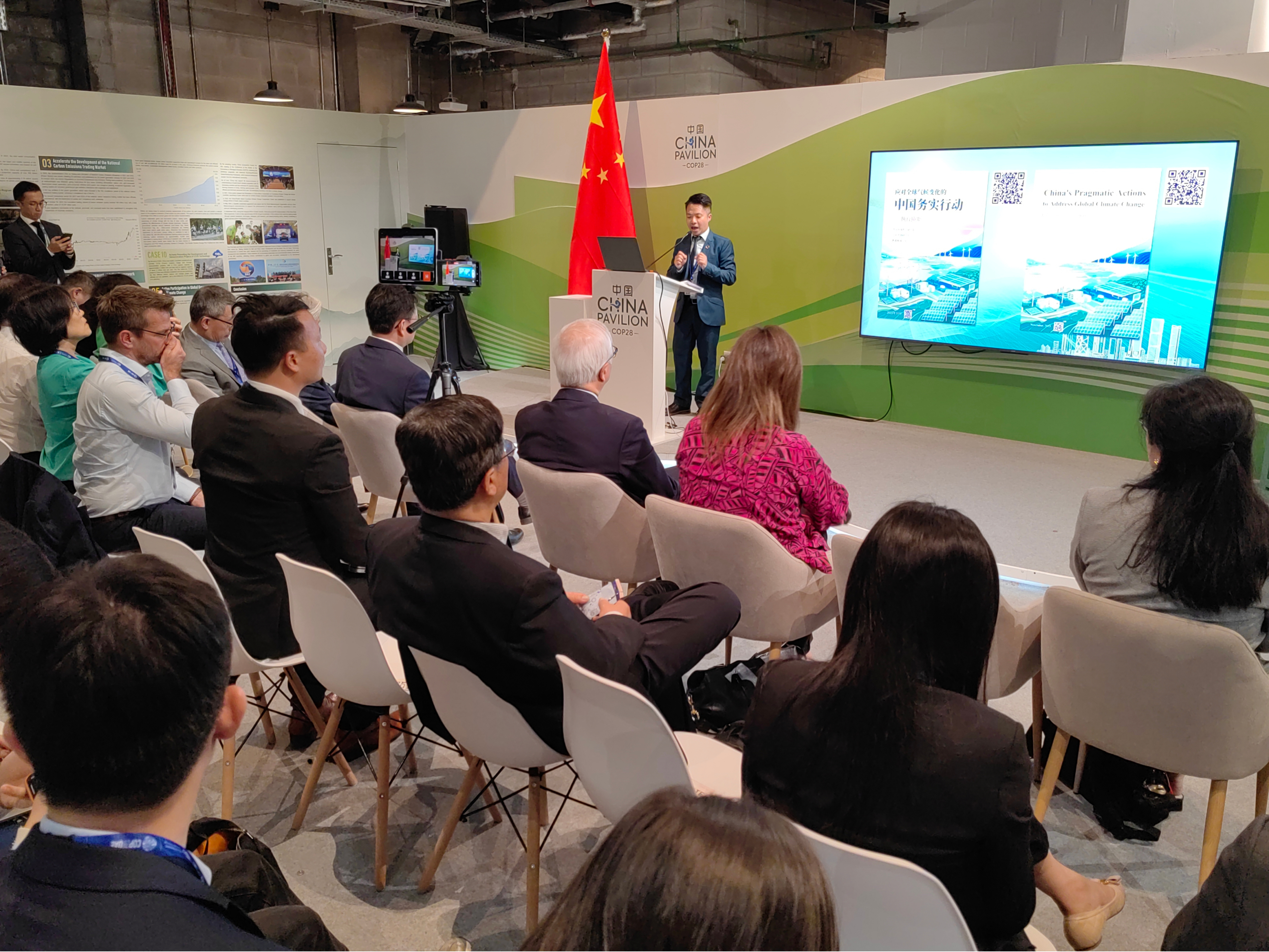
Climate change is a crisis that concerns all of humanity, and must be addressed with multiple participation and coordination. To this end, experts from the Chinese Academy of Environmental Sciences, the Institute of Public and Environmental Affairs and Friends of the Earth Hong Kong jointly set up a research group to summarize the ten practical actions taken by China to address climate change and implement the "dual carbon" commitment, based on publicly collected data and data, and analyze how China can carry out top-level design, form an overall strategy, and guide regional, industry and social pragmatic actions. The research group believes that China has made positive progress in the process of implementing the "dual carbon" commitment and the Paris Agreement, and has formed a significant potential for acceleration.
China's 10 pragmatic actions to address global climate change are: China's primary pragmatic action to actively respond to climate change and implement its "dual carbon" commitment is to build a "1+N" policy system and form an overall plan starting from the top-level design, and China to actively respond to climate change and implement "dual carbon" The second action pledged is to lead the region through pilot demonstrations, accelerate the energy transition through large-scale renewable energy development, promote energy conservation, carbon reduction and efficiency improvement in the industrial and energy sectors, promote the green development of urban and rural construction and significantly reduce carbon emissions in the building sector, promote low-carbon transportation in cities, improve carbon sink capacity, strengthen the construction of green finance and carbon markets, promote green and low-carbon national actions, expand bilateral and multilateral international cooperation, and work with other countries to jointly address climate change.
Dr. Yang Pingjian, co-leader of the project, said that although countries around the world have made positive progress in the process of implementing the Paris Agreement, there is still a long way to go to reduce emissions required for the 1.5°C temperature rise target. Stability and consistency, solidarity and cooperation, and practical focus on practical actions, calling on leading enterprises and financial institutions to implement climate commitments and promote effective emission reduction in supply chains, and advocating the public to practice green lifestyles, and forcing low-carbon transformation at the production end through green choices, so as to help the global zero-carbon sprint and jointly protect the earth's homeland.
Professor Tai Pui-kuen, Director of Friends of the Earth (Hong Kong) and Professor of Earth and Environmental Sciences of the Faculty of Science of the University of Chinese of Hong Kong, released the report on behalf of the expert group, and the Secretary for Environment and Ecology of the Hong Kong Special Administrative Region, Mr. Tse Chin-wan, Secretary for Environment and Ecology of the Hong Kong Special Administrative Region, Ms Yan Meiwei, Permanent Secretary for Financial Services and the Treasury of the Hong Kong Special Administrative Region, Fung Wah-kin, Vice Chairman of the Financial Services Development Council, Ma Jun, Chairman and President of the Hong Kong Green Finance Association, Mr. Ye Guangtao, Chairman of Friends of the Earth (HK), and Ma Jun, Director of the Institute of Public and Environmental Affairs, attended the press conference.


