


The largest carbon emitter in the manufacturing industry: the short, medium and long-term path to decarbonization of the steel industry
Text: Chen Mengmeng, Pan Congchao, Zheng Hui
China is the world's largest consumer and producer of steel. According to worldsteel data, the apparent consumption of crude steel and finished steel in Chinese mainland in 2022 will be about 1.018 billion tons and 921 million tons, respectively, accounting for 54% and 51.7% of the global total.
As an important "industrial food", steel is the cornerstone of the country and supports the rapid development of China's economy. But at the same time, the steel industry is also a major source of domestic carbon emissions, second only to the power sector, accounting for more than 15% of the country's total emissions. In 2022, China's steel industry emitted more than 1.8 billion tonnes of carbon. If the global average temperature rise is to be limited to 1.5°C by the end of the century, China's steel industry will need to reduce emissions by about 100% by 2050.
At present, the steel industry is facing huge pressure to reduce emissions, both internally and externally. In 2020, China put forward the "dual carbon" goal, and the steel industry is the first source of carbon emissions in the industrial sector. At the same time, developed countries are setting up "green trade barriers", and Chinese steel companies will face the challenges of rising export costs, shrinking price advantages and declining product competitiveness.
The steel industry itself urgently needs to decarbonize. In addition, steel is the main raw material in infrastructure construction, automobile manufacturing, equipment manufacturing, construction and other fields, from the perspective of product life cycle, the steel industry to achieve low-carbon transformation is of great significance for driving the carbon reduction action of the whole society dominated by manufacturing and construction industries.
China's coal-based energy structure and long-process process structure have led to China's carbon emissions per ton of steel being higher than the world average. In the short term, promoting the optimization of the stock of the steel industry by means of dual control of production capacity and output, energy-saving and technological transformation is the priority emission reduction path in the peak stage; In the medium term, optimizing the process structure and promoting the transformation of the energy structure are effective means to consolidate the foundation for peaking and move towards carbon neutrality. In the long run, breakthrough hydrogen metallurgy technology is the core of the steel industry to achieve carbon neutrality in the future, and CCUS (carbon dioxide capture, utilization and storage) technology will be the foundation for the eventual realization of carbon neutrality.
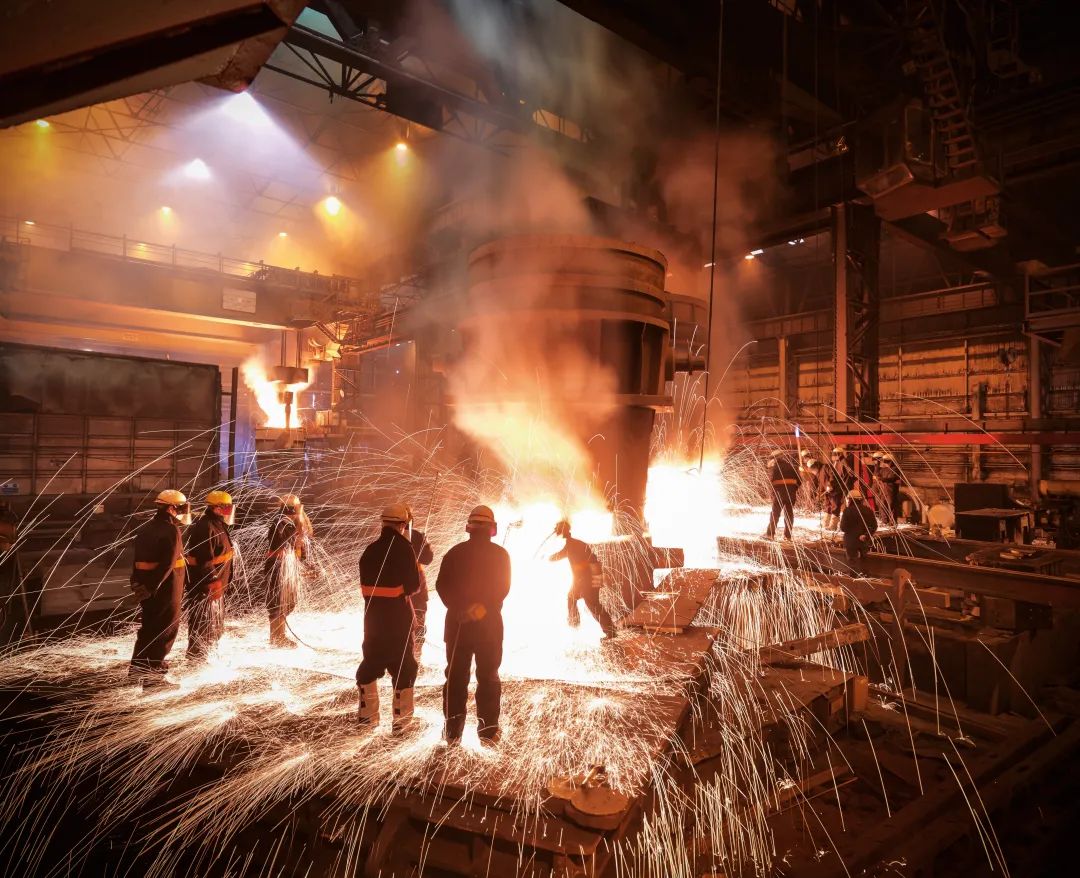
Deepening supply-side reform, deepening capacity reduction, reducing output, and promoting stock optimization are the key tones for the development of the steel industry. Photo/Visual China
Short-term: energy-saving technological transformation, reducing output
Between 2010 and 2020, the comprehensive energy consumption per ton of steel in China's steel industry has decreased by 17.9%, but there is still a gap compared with developed countries, and the energy intensity still has the potential to decline by 15%-20%. By the end of 2020, the energy efficiency of domestic blast furnace and converter processes is lower than the benchmark level of about 30%, and the production capacity better than the benchmark level is only 4% and 6% respectively, and the industry as a whole has great room for improvement.
Energy conservation and consumption reduction do not contribute much to the long-term overall carbon reduction of the steel industry, but it is more acceptable to iron and steel enterprises because of its economic benefits.
According to the research on the "marginal emission reduction cost model of the steel industry" of Zhongchuang Carbon Investment, under the enhanced emission reduction scenario, by the end of the "15th Five-Year Plan" (2026-2030), the total carbon emissions of the steel industry will drop by 390 million tons, of which the application of energy-saving and emission reduction technologies will bring about 17 million tons of emission reduction. Although the emission reduction contribution only accounts for 12.22%, thanks to the high maturity of the technology, the economic benefits brought by production efficiency are higher than the comprehensive technical cost, and the average emission reduction cost is -348.47 yuan/tCO2, which has obvious economic benefits compared with other emission reduction technologies.
Fu Jianguo, deputy general manager of Baoshan Iron & Steel Co., Ltd., also said at the "Empowering Progress" summit jointly organized by Shell and Caijing magazine in July 2022: "Energy conservation is a national strategy, and with the price of energy rising, the price and cost of energy in steel products are close to 50%, and we are very motivated to carry out this activity." ”
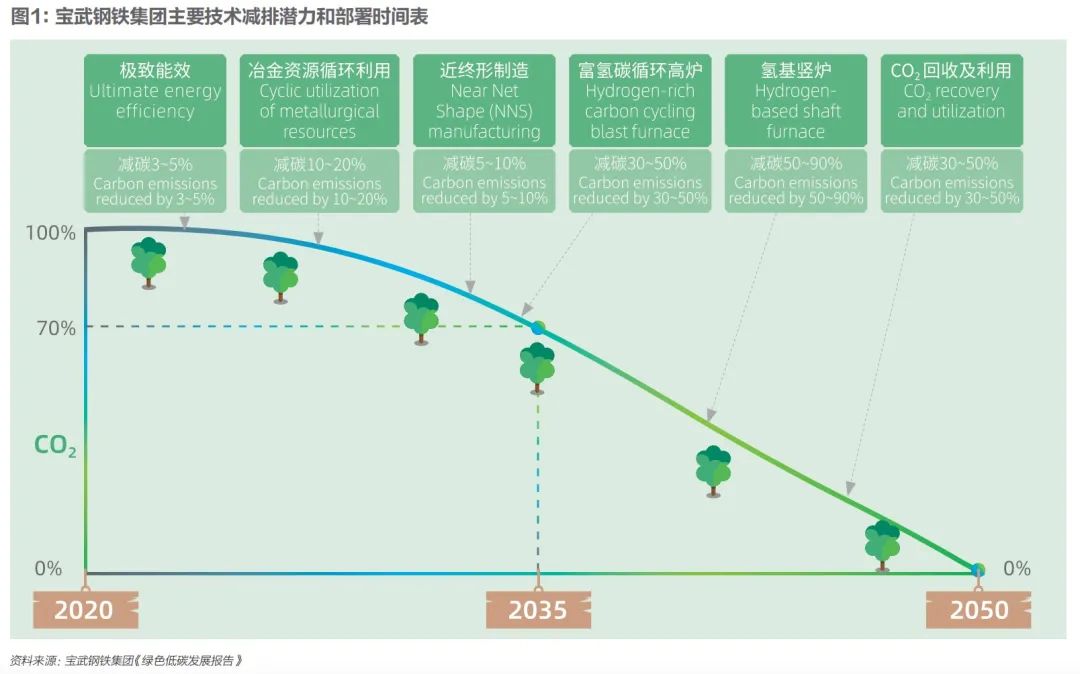
Baowu Iron & Steel Group (hereinafter referred to as "Baowu") is the world's largest iron and steel enterprise, consisting of Baosteel Co., Ltd., Zhongnan Iron and Steel Group, Masteel Group, TISCO Group and Bayi Iron and Steel Group. In its "Green and Low-Carbon Development Report", Baowu mentioned that it will focus on the innovation and application of waste heat and energy recycling, improving interface energy efficiency, realizing the improvement of energy efficiency in the whole process, and challenging the ultimate energy efficiency, with a potential emission reduction of 3%-5%.
As crude steel production in the steel industry is still at a high level, even if the energy efficiency level continues to improve, the scale of carbon emissions in the steel industry is still huge. Therefore, deepening supply-side reform, strictly controlling production capacity and output, and promoting stock optimization are the most direct and effective means to reduce carbon emissions in the steel industry in the short and medium term.
In 2021, the Ministry of Industry and Information Technology issued a new version of the "Implementation Measures for Capacity Replacement in the Iron and Steel Industry" to further increase the proportion of capacity replacement, require the expansion of strong control areas, and encourage enterprise mergers and acquisitions to improve industrial concentration, and then issued the "14th Five-Year Plan" for the development of raw material industry, which also clearly requires that by 2025, crude steel production capacity will only decrease but not increase, and capacity utilization will remain at a reasonable level. In the "1+N" policy of carbon peak and carbon neutrality, it also emphasizes the development tone of the industry in the steel industry to deepen supply-side reform, deepen capacity reduction, reduce output, and promote stock optimization.
Baowu Group has started the "reduction" work since 2016. Baowu proposed that it will reduce carbon dioxide emissions by about 40 million tons per year through dissolving production capacity and about 11 million tons of carbon dioxide emissions per year through energy efficiency improvement.
Medium-term: Optimize the process structure and promote the transformation of the energy structure
There are three main production processes in the steel industry: "blast furnace + converter" process, "hydrogen-based direct reduction + electric furnace" process, and "scrap + electric furnace" process, among which the "scrap + electric furnace" process has the lowest carbon emission intensity.
The process structure based on the traditional long process (blast furnace + converter) largely determines the characteristics of high energy consumption and high emissions in China's steel industry. It is estimated that China's carbon emissions per ton of crude steel are about 2.35 tons of carbon dioxide, which is higher than the world average of about 1.91 tons. The short-process (scrap + electric furnace) process directly uses reduced iron as raw material and is reduced by electrolysis, and the carbon emission intensity is only 0.87-1.25 tons CO2/ton.
Short processes not only help to reduce carbon emissions, but also promote resource recycling and ensure resource security. Steel scrap is a green resource for energy conservation and carbon reduction, and it is also the only source of iron that can replace iron ore. China's dependence on foreign iron ore is as high as more than 80%, and the import of iron ore in 2021 was about 1.12 billion tons, accounting for 70% of the world's iron ore exports. Making full use of scrap resources will help alleviate dependence on external resources.
However, in 2021, Chinese mainland's electric furnace steel production accounted for only about 10.6%, far lower than the 69.2% of the United States, 43.9% of the European Union, and 25.3% of Japan. In addition, the capacity utilization rate of electric furnace steel is less than 60%. Baowu Group reported that its electric furnace steel production accounted for only about 6.5% of crude steel production.
The lack of scrap resources and the high price have hindered the further development of electric furnace steelmaking. The production cost per ton of steel in the short process of electric furnace is about 300 yuan to 600 yuan higher than that in the long process, of which scrap accounts for more than 75% of the short process steelmaking cost and about 6%-15% of the electricity cost. It is estimated that under the current market situation, when the price of scrap steel is 1600 yuan/ton, the electric furnace steel will be competitive, and the current scrap price is still at a high level of 2500 yuan/ton.
The misallocation of resources between electricity and scrap is also a major dilemma in the development of electric furnace steel. Electricity accounts for about 80% of the total energy consumption of the short process, and the cost of electricity has a great impact on the short process. With the "Hu Huanyong Line" as the boundary, iron and steel enterprises, electricity demand and scrap resources are mainly concentrated in the central and eastern regions, while cheap electricity and renewable resources are mainly distributed in the northwest region. From the perspective of capacity distribution, the electric furnace production capacity is mainly concentrated in East China and South China, which account for about 54.3% of the total electric furnace production capacity, while the production capacity distribution in the southwest and northwest regions with abundant electric energy is only 12.3% and 3.7%.
Baowu plans to build the world's first steel short-process "zero-carbon factory" demonstration production line covering an area of 4.7 square kilometers in Bazhou Iron and Steel, Xinjiang, and form a "photovoltaic green power + electric furnace + thin strip continuous casting and rolling" green zero-carbon steel short-process demonstration project. The project will be built by Bagang, and the production line will achieve zero carbon emissions through the use of photovoltaic green electricity and forestry carbon sinks.
Long-term: Breakthrough in hydrogen metallurgy technology, with CCUS as the bottom
The basic principle of hydrogen metallurgy is to use hydrogen as a reducing agent instead of carbon to reduce iron oxides to metallic iron. Since there is no carbon element in the hydrogen reduction process, no greenhouse gases such as carbon dioxide are produced, which fundamentally reduces the carbon emissions in the smelting process.
Hydrogen metallurgy is the most critical solution to achieve the zero-carbon development of the iron and steel industry, and at present, the world's major iron and steel leading enterprises are actively carrying out hydrogen metallurgy technology research and capacity layout, and gradually formed two hydrogen metallurgy technology routes with hydrogen-rich blast furnace and hydrogen-based shaft furnace as the core. According to the emission reduction model of Zhongchuang Carbon Investment Industry, hydrogen metallurgy technology can achieve a carbon reduction of 71 million tons in the carbon peak stage of the steel industry.
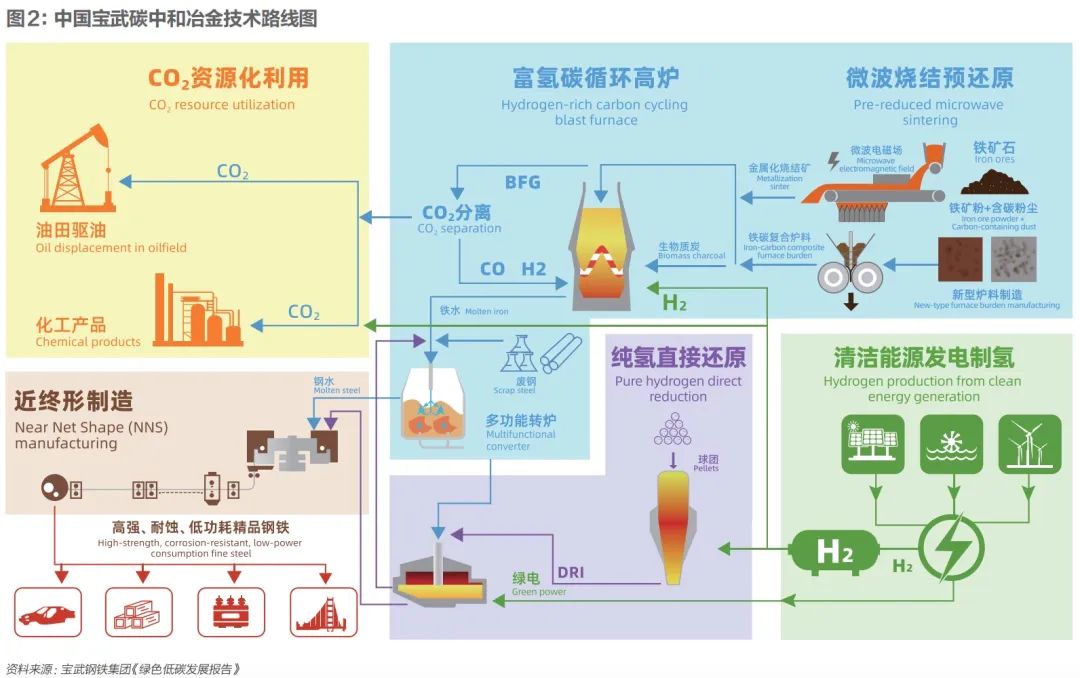
Baowu mentioned in the report that the blast furnace is an extremely efficient reactor that can provide the cleanest raw materials for steelmaking, and its efficiency and status are difficult to be completely replaced by other processes for a long time. By taking the hydrogen-rich carbon cycle as a means and reducing the ratio of reducing the reducing agent ratio of the blast furnace, the blast furnace process can be reconstructed, the chemical energy of carbon can be maximized, and the carbon heating can be replaced by industrial green electrification, which can achieve a significant carbon reduction in the blast furnace process.
Fu Jianguo also said that Baosteel has a large number of long-process assets, if this asset is abandoned, it means a huge loss to the steel industry, and is currently actively investing in some new metallurgical technologies to reform the traditional long-process metallurgical process.
In July 2022, the world's first 400 cubic meter industrial-grade hydrogen-rich carbon cycle oxygen blast furnace HyCROF was officially unveiled and ignited and put into operation in Bagang Company.
The project has lasted for many years: in 2019, China Baowu started the renovation of the abandoned 430 cubic meter blast furnace of the Eight Iron and Steel Company; At the end of 2020, it became the world's first blast furnace to achieve the goal of 35% oxygen-rich smelting; In June 2021, the company realized the injection of decarbonized gas and coke oven gas at the tuyere, which is the first case of decarbonization gas recycling in the world's blast furnace, with a carbon reduction effect of more than 15%.
In addition to the all-oxygen hydrogen-rich gas cycle that has been implemented, the project will also plan the construction of a production line for photoelectric hydrogen production and CO2 resource utilization, forming a complete 430 cubic meter industrial blast furnace low-carbon metallurgical demonstration production line and pilot plant.
According to Baowu's plan, around 2035, hydrogen-rich cycle blast furnace technology will begin to help reduce carbon emissions, with an estimated carbon reduction potential of 30%-50%, followed by hydrogen-based shaft furnaces, with an estimated carbon reduction potential of 50%-90%.
Ideally, the hydrogen-based shaft furnace process scheme can use clean energy to produce hydrogen and use hydrogen to reduce iron ore to make iron, which is expected to achieve near-zero carbon emissions in the steel smelting process.
Baosteel Zhanjiang Iron and Steel, Zhongjin Taihang, Hegang Zhangxuan Technology and other companies are trying to promote hydrogen-based shaft furnace projects.
Taking Baosteel's Zhanjiang Iron & Steel project as an example, the project plans to build a set of green hydrogen full-process zero-carbon plant, of which the million-ton shaft furnace project has been laid at the end of 2021 and is expected to be completed by the end of 2023, which can reduce carbon dioxide emissions by more than 500,000 tons per year compared with the traditional pre-iron blast furnace ironmaking process of the same scale of molten iron.
According to the plan, in the future, the project will use natural gas in the South China Sea, and even use photovoltaic and wind energy in the South China Sea to produce hydrogen, forming a full-cycle and closed process that matches the iron and steel metallurgical process, reducing carbon emissions by more than 90% in the long process of production lines, and realizing a zero-carbon plant in the whole process of green hydrogen through carbon capture and forest carbon sinks.
Low-carbon metallurgical technology is a "no man's land" that lacks imitation objects, and it is necessary to accelerate innovation and promote technological research. In November 2021, Baowu initiated and joined hands with partners in the global steel industry and ecosystem to jointly launch the "Global Low Carbon Metallurgy Innovation Alliance".
At the same time, Baowu has set up a low-carbon metallurgy innovation fund for the whole society, providing funds of less than 35 million yuan per year, focusing on funding basic and applied basic research in the field of low-carbon metallurgy.
According to the 2020 steel industry technology roadmap released by the International Energy Agency (IEA), it is estimated that by 2050, the steel industry will still have 34% of carbon emissions left after conventional emission reduction measures such as process improvement, efficiency improvement, energy and raw material substitution, and even if breakthroughs in hydrogen metallurgy technology are made, the remaining carbon emissions will exceed 8%. Therefore, CCUS will be the backing technology for the eventual realization of carbon neutrality.
At present, China's CCUS demonstration projects are small in scale and high in cost, and the layout is mainly concentrated in power generation, petrochemical and other industries, and individual iron and steel companies have just begun to explore.
In November 2022, Baosteel signed a memorandum of understanding with PetroChina, Shell and BASF to jointly launch China's first open 10-million-ton CCUS project in East China. In the same month, the geotechnical engineering survey of the first phase of the 500,000-ton demonstration project of the 2 million ton CCUS project of Baotou Steel Group was fully completed, which is the first CCUS whole industry chain demonstration project in the steel industry and will be divided into three phases of construction.
epilogue
As the second largest source of carbon emissions after the power generation industry, emission reduction in the steel industry is crucial to achieving the goal of carbon peak and carbon neutrality. However, as with any industry, this is not something that can be achieved by the industry alone, and requires downstream users, governments, financial institutions and other parties to work together to form a joint force.
A senior executive in the steel industry mentioned in an exchange with Caijing that the European user group has clearly put forward carbon reduction requirements, and the government has also built a relatively complete trading mechanism, so European steel companies are more motivated to reduce carbon emissions and have a clearer route. However, many downstream industries in China are still waiting and seeing, and the demand of the automotive industry is relatively clear, but most of the manufacturing and construction industries do not have clear demand. In addition, the steel industry has not yet been included in the national carbon market, and it is still a vague question for the industry to see when and whether it will be rewarded after investment. "As soon as possible, the route is clear, and enterprises can plan as soon as possible, which involves a lot of money, but also involves when the existing assets will end their life cycle, the process of switching from long process to short process, etc., whether they can grasp the right time, is a matter of life and death for the industry."
(The authors Chen Mengmeng and Pan Congchao are senior analysts of China Innovation Carbon Investment Research Institute, and Zheng Hui is a researcher at the Industry Research Center of Caijing magazine; Editor: Mark. For a more detailed analysis, please refer to the "White Paper on the Low-Carbon Development Path of Iron and Steel Enterprises" to be released by Zhongchuang Carbon Investment)
This article is from the WeChat public account"Caijing Eleven" (ID: caijingEleven), Author: More than eleven people, 36 Krypton is published with permission.


