


Current status and outlook of the global voluntary emission reduction mechanism
As the core of the operation of the voluntary carbon market, the voluntary emission reduction mechanism is a set of rules, procedures and methods for the certification and issuance of carbon credits. The project owner or developer independently selects and implements the corresponding carbon credits through the verification and verification of a third-party audit agency, and then trades or offsets them in the voluntary carbon market. Voluntary emission reduction mechanisms can provide financial incentives for various emission reduction projects, promote the promotion and application of low-carbon technologies, and provide more options for carbon credit buyers to help them achieve their own climate goals or social responsibilities.
1. The relationship between the voluntary emission reduction mechanism and the mandatory carbon market
Voluntary emission reduction mechanisms and carbon markets are two different but interrelated ways to reduce carbon emissions. A voluntary emission reduction mechanism refers to a mechanism for enterprises or organizations to independently establish, implement, monitor, report and account for greenhouse gas emission reduction action plans. This mechanism emphasizes that companies voluntarily take action to reduce greenhouse gas emissions in situations not provided for by national laws and regulations, and are subject to third-party audits and verification. Voluntary emission reduction mechanisms give companies greater flexibility and autonomy to set emission reduction targets and plans based on their own needs. The carbon market is a market mechanism based on the mandatory carbon emission reduction mechanism stipulated by the government. Through the establishment of carbon emission quotas, carbon trading, carbon taxes and other measures to guide enterprises or organizations to reduce greenhouse gas emissions, and provide economic incentives for units with less emissions.
Although the emission reduction methods are different, there is still a certain connection and interaction between the voluntary emission reduction mechanism and the carbon market. First, the common goal of both the voluntary emission reduction mechanism and the carbon market is to reduce greenhouse gas emissions and contribute to the global emission reduction process. The voluntary emission reduction mechanism promotes the popularization and strengthening of global emission reduction awareness by encouraging enterprises to actively participate in emission reduction actions. At the same time, as a mandatory emission reduction mechanism, the carbon market guides enterprises to reduce carbon emissions through economic means, providing effective support and impetus for the realization of global emission reduction goals. Second, voluntary emission reduction mechanisms can provide companies or organizations with reliable proof of carbon emission reductions to trade in the carbon market. The carbon credits obtained by enterprises through the implementation of their own emission reduction plans can be sold in the carbon market, thereby obtaining economic returns. At the same time, the carbon market also provides more options and opportunities for companies to purchase carbon credits to meet their emission reduction targets.
2. The main application scenarios of the voluntary emission reduction mechanism
Provide offsets for a mandatory carbon market. Some mandatory carbon markets allow regulated companies to offset some or all of their emissions using carbon credits under international voluntary emission reduction schemes to reduce compliance costs or increase flexibility. For example, the EU ETS allows the aviation industry to offset its emissions using carbon credits under the Clean Development Mechanism (CDM), and the Carbon Offsetting and Reduction Mechanism for International Aviation (CORSIA) allows the use of voluntary emission reduction credits such as Certified Emission Reduction Standards (VCS), Gold Standard (GS), CDM, China Certified Voluntary Emission Reductions (CCER) to offset carbon emissions from international aviation that exceed the baseline.
Provide incentives for non-mandatory carbon markets. Some countries or regions that do not participate in the mandatory carbon market can encourage and support voluntary greenhouse gas emission reduction projects by establishing domestic voluntary mechanisms or participating in independent voluntary mechanisms of third parties, so as to promote low-carbon development and sustainable development. For example, China has established a Certified Voluntary Emission Reduction (CCER) mechanism to provide policy support and market incentives for various voluntary emission reduction projects, while also allowing CCERS to offset no more than 5% of carbon emissions from the mandatory carbon market. Other countries or regions can also participate in third-party independent voluntary mechanisms such as VCS and GS to quantify, verify and register the emission reduction effects of projects through third-party certification institutions, and issue corresponding carbon credits. These carbon credits can be sold on the voluntary carbon market to demanders, such as green businesses or individuals, thus providing an additional revenue stream for the project.
Provide a path to carbon neutrality for businesses and individuals. Some enterprises and individuals with a sense of social responsibility or brand image can achieve their own carbon neutrality or carbon neutrality goals by purchasing carbon credits under the international voluntary emission reduction mechanism, so as to enhance their environmental reputation or meet their environmental protection concepts.
International carbon trading is mainly divided into three steps: the first step is to determine the applicable mechanism of the enterprise itself. For enterprises, they need to ensure that their emission reduction actions meet these standards and can be verified by certification according to industry and regional requirements, as well as the standards and certification requirements of different voluntary emission reduction mechanisms. The second step is to obtain certified emission reductions. After determining the appropriate emission reduction mechanism, apply for and implement carbon reduction projects according to the provisions of the emission reduction mechanism, so as to obtain corresponding carbon credits. The third step is to put it on the market to achieve its own carbon reduction goals.
3. Mainstream emission reduction mechanisms
At present, there are many global voluntary emission reduction mechanisms, the mainstream ones are Clean Development Mechanism (CDM), Gold Standard (GS), Verified Carbon Standard (VCS), The Standard for Verified Emission Reductions (VER+), and Chicago Climate Standard Exchange, CCX), Climate Action Reserve (CAR), The Climate, Community & Biodiversity Standards (CCB), The Plan Vivo Standards, Plan Vivo, etc.
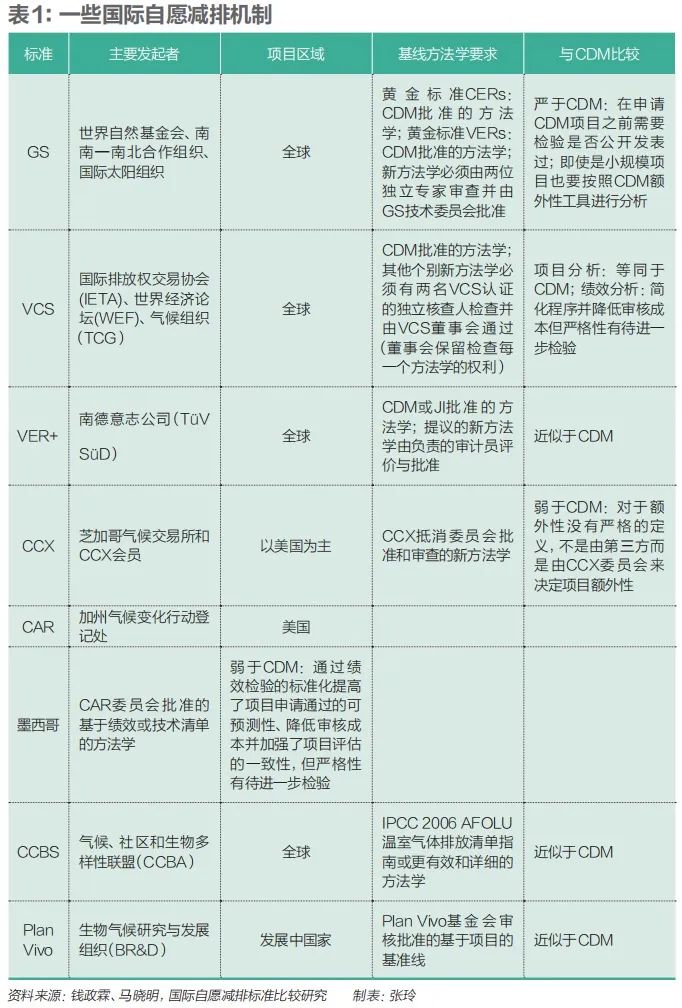
The following are three relatively well-established mechanisms for voluntary international emission reductions.
Clean Development Mechanism (CDM)
1992年,面对气候变化加剧的共同挑战,联合国大会通过了《联合国气候变化框架公约》(United Nations Framework Convention on Climate Change, UNFCCC),建立起全球协同合作应对气候变化风险的体系架构。1997年联合国第三届气候变化大会通过的《京都议定书》中,提出了Clean Development Mechanism (CDM)。
CDM is a mechanism proposed at international climate change conferences on how to solve the problem of global warming and how to reduce greenhouse gas emissions. The main content is that economically and technologically advanced countries use their own financial and technological advantages to cooperate with developing countries to develop projects in order to reduce greenhouse gas emissions. Developed countries have implemented such projects to fulfil their commitments under the Kyoto Protocol.
On the one hand, CDM is conducive to developing countries to obtain abundant funds, advanced technology and equipment that are lacking in developed countries to promote the realization of sustainable development strategies of developing countries. On the other hand, developed countries need to purchase carbon emission reduction certifications for their own development projects, and the price cost of carbon emission reduction certifications is high, and the cost can be reduced if they cooperate with developing countries to develop CDM projects. CDM is also the basis for other mainstream voluntary emission reduction mechanisms.
At present, the CDM methodology covers different emission reduction projects in 15 industries, such as energy, manufacturing, chemicals, and transportation, and provides methods and requirements for the baseline setting of their projects. There are three main steps from design to issuance of CERs in a CDM project, namely project design, validation and registration, and issuance of CERs.
Gold Standard (GS)
黄金标准(Gold Standard, GS)由黄金标准基金会管理,世界自然基金会(WWF)和其他非营利性组织共同设立。GS的愿景是“所有人的气候安全和可持续发展”,旨在确保在联合国Clean Development Mechanism (CDM)下减少碳排放的项目也履行促进可持续发展的双重任务。
GS embraces the CDM methodology and adds some GS-specific elements to the CDM methodology, such as sustainability indicators, community consultation, environmental impact assessment, etc., and GS provides more than 30 additional methodologies covering nine areas: land use, forestry and agriculture, energy efficiency, fuel switching, renewable energy, shipping energy efficiency, waste treatment and disposal, water efficiency, carbon dioxide removal, and sustainable transportation solutions.
GS acts as an independent standards and certification body for the registration and certification of CDM programs. CDM projects can apply to pass the GS Gold Standard certification to increase the credibility and added value of the project.
Verified Carbon Standard (VCS)
The Verified Carbon Standard (VCS) is the world's most widely used greenhouse gas credit scheme, jointly sponsored by the International Emissions Trading Association (IETA), the World Economic Forum (WEF), and the Climate Group (TCG). It drives financial flows to activities that reduce and eliminate emissions, improve livelihoods, and protect nature. VCS projects have reduced or eliminated nearly 1 billion tonnes of greenhouse gas emissions from the atmosphere.
The VCS accepts methodologies from CDM and offers an additional 45 methodologies covering industries such as energy, manufacturing, construction, transportation, mining, and more. The carbon reduction certification obtained through VSC's projects is called VCUs (Verified Carbon Units). VCUs are characterized by having some quality assurance principles. These principles are confirmed through the project validation and verification process, as well as Verra's review and approval. The Verra Registry is the management platform for VCS and VCU, and ownership of VCUs can only be transferred between Verra accounts, and VCUs cannot be transferred to other databases or traded as paper certificates. Verra guarantees the quality and credibility of the VCU through a rigorous user review mechanism.
4. Issues and prospects for global carbon offset mechanisms
What is the quality and reliability of carbon credits?
Due to the lack of uniform standards and regulation of voluntary carbon offset mechanisms, different projects may adopt different methodologies, baselines, monitoring and verification methods, resulting in differences and uncertainties in the quality and reliability of carbon credits. For example, in January 2023, the Guardian questioned the existence of large amounts of overestimated/worthless carbon credits for REDD+ projects under the VCS standard, based on several studies from the University of Cambridge, and questioned Verra's impartiality. In February 2023, Verra launched the AMS-III. AU.: Reducing Methane Emissions by Adapting Water Supply Management Practices in Rice Cultivation" and immediately suspended all project development activities using the methodology (including project registration and emission reduction issuance). On Verra's methodology page, AMS-III. AU. has been listed as "N/A".
The phenomenon of methodological freezing reflects the high-risk characteristics of the carbon offset and emission reduction trading market with high policy uncertainty. Some recognized international voluntary emission reduction mechanisms (such as VCS), which have been considered relatively stable and reliable in the past, are no exception. However, in general, in the context of the continuous growth of the market's demand for carbon offsets, the event itself just reflects the growing demand for high-quality, high-standard emission reduction mechanisms and emission reduction markets and trading models. Skepticism will also push the market in a more regulated direction.
There are problems with double counting and use of carbon credits.
Since the voluntary carbon offset mechanism involves multiple countries and regions, there may be a risk that carbon credits will be included in the emission reduction targets or contributions of two or more countries or regions at the same time, resulting in double counting. In addition, there may be a risk that carbon credits will be used or sold multiple times by the same or different market participants, resulting in reuse. These issues can lead to overestimation of actual emission reductions, affecting environmental integrity and market fairness.
For these reasons, carbon credits need to be standardized and certified.
为了提高碳信用额的质量和可靠性,一些国际组织和机构已经开发了一些标准和认证体系,如核查减排标准(VCS),Gold Standard (GS),气候、社区与生物多样性标准(CCB)等。这标志着国际社会已经认识到减排机制规范化的重要性。这些标准和认证体系可以为项目开发者提供指导和规范,为市场参与者提供保障和信心,以确保碳信用额的有效性和互认性,为监管部门提供参考和依据。
(The author is an analyst at Zhongchuang Carbon Investment Research Institute; Editor: Liu Jianzhong)
This article is from the WeChat public account"Caijing Eleven" (ID: caijingEleven)Author:Zhang Chongwu, 36Kr is published with permission.


